
Here in Izmir, Turkey, Imece Initiative is supporting many people who have come from the Democratic Republic of the Congo (DRC). People from the Congo, especially eastern DRC, are fleeing a decades-long war, deliberate attacks on civilians by armed militias and what many are calling ‘a hidden genocide’, as well as poverty, acute food insecurity, and more; however when they get to Turkey the situation can be very difficult for them here too. Recently Imece is encountering a number of situations where people have easily-treatable health problems, but due to difficulties in securing paperwork to gain access to basic healthcare, their health problems are now life-threatening.
In this blog post, I speak to wonderful Gloria, a social worker here at Imece who has also become my dear friend. She told me about the people she is supporting here in Turkey, and also about what she saw when she volunteered in Goma, in the heart of the conflicted area in eastern Congo. The good news is, there are some small things we can all do to help.
Meet Gloria

If you meet Gloria, the first thing that you will notice is that she is always looking super stylish, whatever the occasion. Gloria is fun and chatty, has a big heart, loves to dance, and can be a sass-queen when she needs to be.
Gloria also works incredibly hard, and has had more than her fair share of personal challenges to overcome, including surviving cancer. She has so many skills I don’t know where to start. When Gloria was just 19 years old she got a scholarship to come from her home in Burundi to another continent to study International Relations in Turkey. The condition was that she quickly become fluent in Turkish – a language she didn’t speak a word of! The University gave Gloria 1 year to get to C3 (the top) level of fluency or she was told she would not be able to study her course and would be sent back to Burundi. “It was very difficult” she told me. “I was so anxious about passing. I cried a lot. I just studied non-stop and barely slept”. Amazingly, with a lot of hard work she pulled it off.
Gloria now speaks fluent Kurundi (her mothertongue), French, English, Turkish, and some Lingala (the main language spoken in the Congo). Her day to day at work is spent listening to displaced people (mainly women) and supporting them to navigate the Turkish system and access legal, medical, social, and psychological help. She also teaches refugee children French, English, and Turkish through songs and dancing – whenever I see her giving these classes the kids are captivated.
Mugunga Camp, Goma
Last year in August 2023, Gloria visited Mugunga camp, the biggest camp for displaced people in Goma, in eastern DRC. At that time there was a big outbreak of violence there between a militia called M23, and government forces. I asked her what she saw when she was there. “It was so terrible. It’s not a life. It’s actually so hard to explain….Because people don’t even have any shelters” she told me. “They are just living on the ground. They dont have any water, children are dying because of lack of food, and they told me at that time there were more than 1 million people living in the camp. And it’s very hard to handle the situation, because more people keep coming because of the war. And there’s just not any assistance for these people. It’s very hard and they are facing so much violence. especially the women and the young girls”.
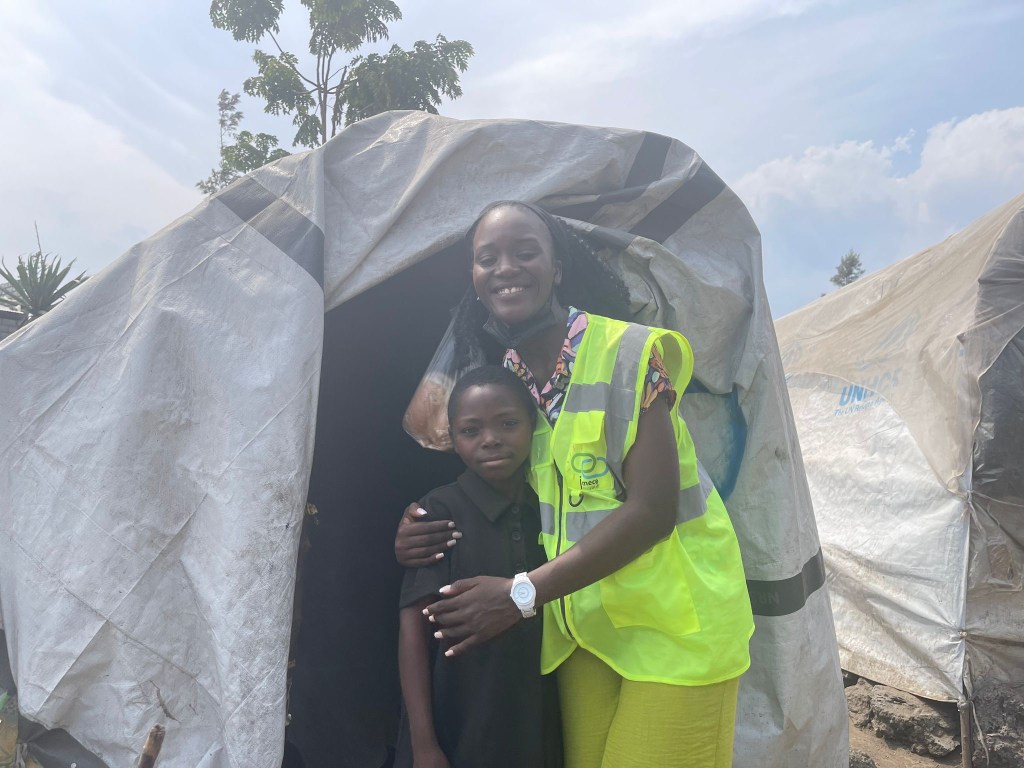
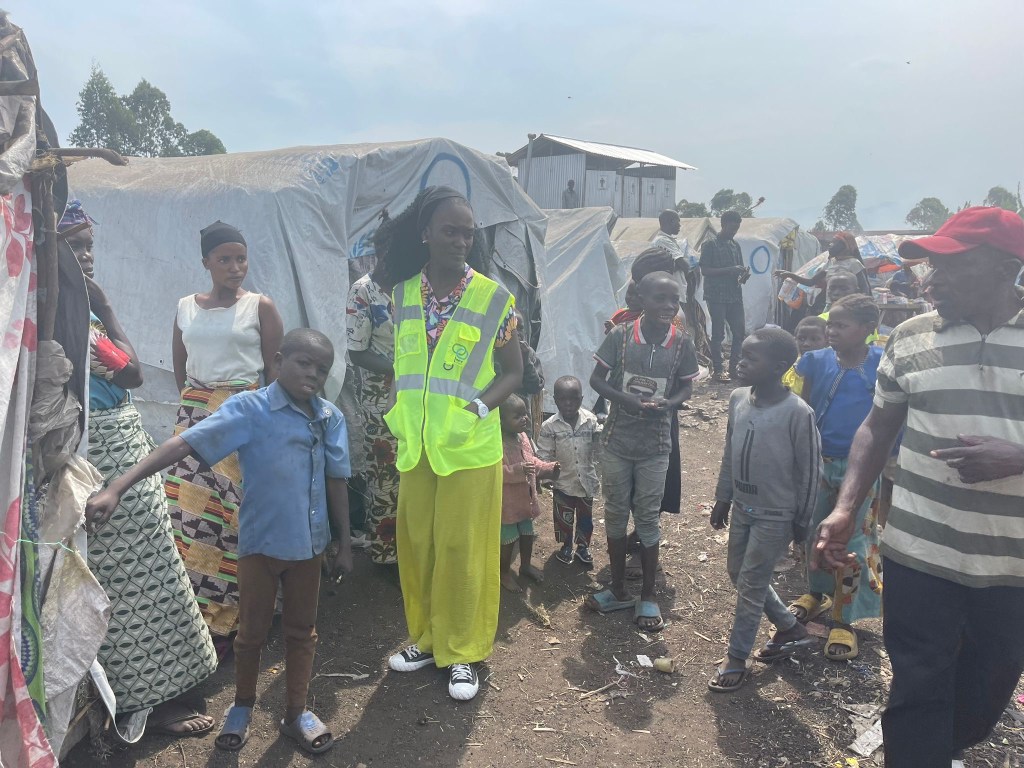
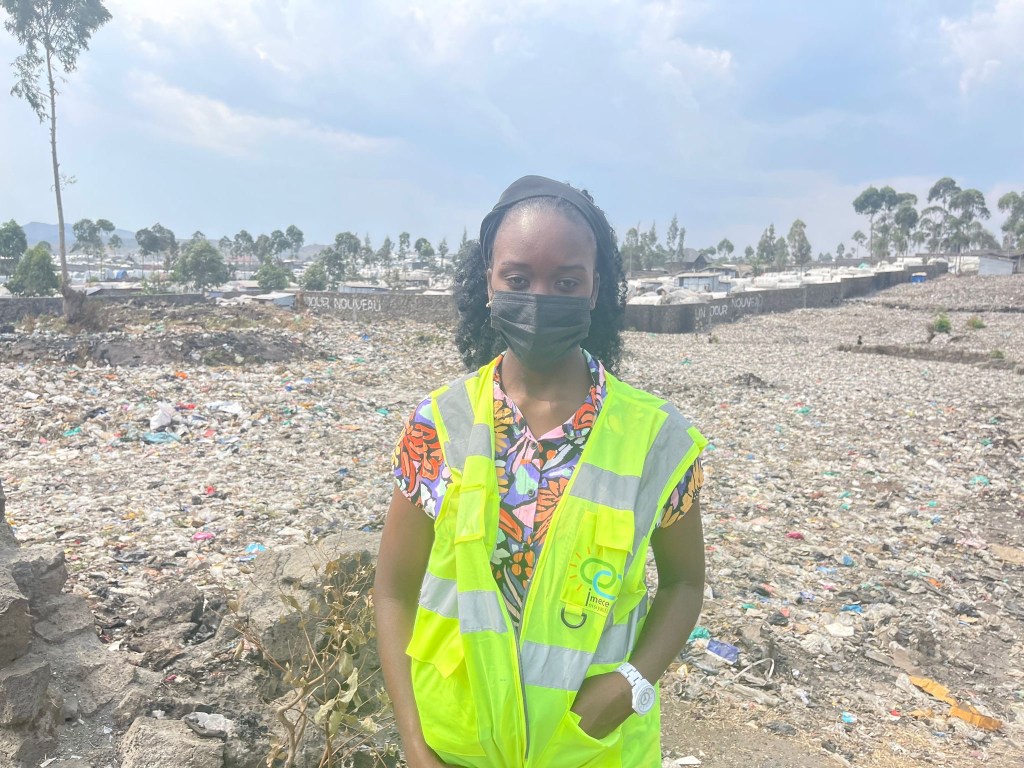
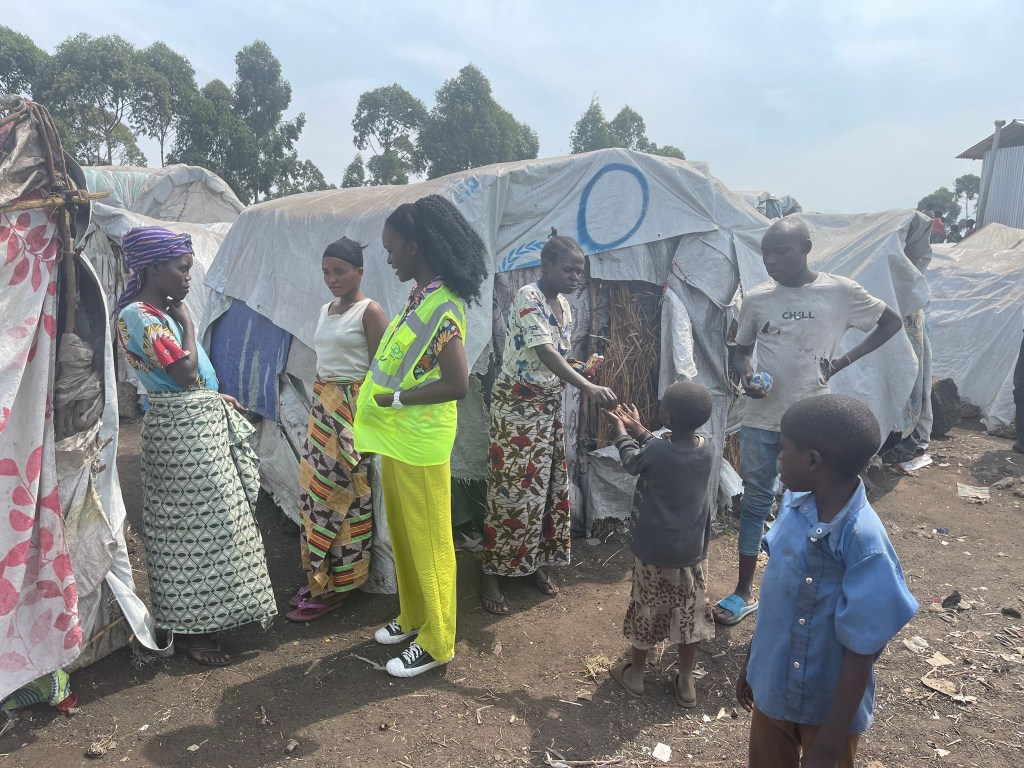
“I met this child (pictured above), and he was selling 1 slice of bread. He lost both his parents, when people were running away from fighting. He just turned and ran and lost both of his parents. He doesn’t even know where they are. Many people are sick. Lack of health there is very very bad. UNHR are there but they were also saying this situation is out of control”.
“I want to appreciate the work and handouts of the people of the City of Goma. I could see many people tried their best to give some charity and do what they could. Unfortunately it’s just not enough”.
Gloria
“And also the place is not safe. I was also approached by these militamen with a knife, asking who I was. So I could see how the people were living”.
So Why is this Happening?
If you do a quick google search on what is happening in the Congo and the causes of the conflict, you may well find yourself feeling confused. Are the problems in the Congo caused by fighting and inhumane working conditions related to cobalt mining? or is American imperialism to blame? Or is it a proxy war between China and other forces, or driven by meddling from neighboring Rwanda and Rwandan President Kagame? Phew…. All sound a little too complicated?
Well, all of these things are true and happening at the same time. But human rights activist Kambale Musavuli gives us a way to simplify what is going on: “Congo has 2 sets of challenges: internal challenges, and external challenges”. Overall Musavuli highlights 6 challenges, listed below. All of the challenges are related to access to the Congo’s abundant natural resources, many of which are essential for our modern day technology and ‘clean’ energy (cell phones, laptops, electric vehicles). The most important take-home message is that the external factors make it very hard for Congolese to free themselves from these challenges. They can’t do it without international solidarity and without us holding our own governments to account for our part in this.
“People are suffering, but while they are suffering they are also organising to liberate themselves from a centuries old challenge where they are not able to determine their own affairs” Kambale Musaveli.
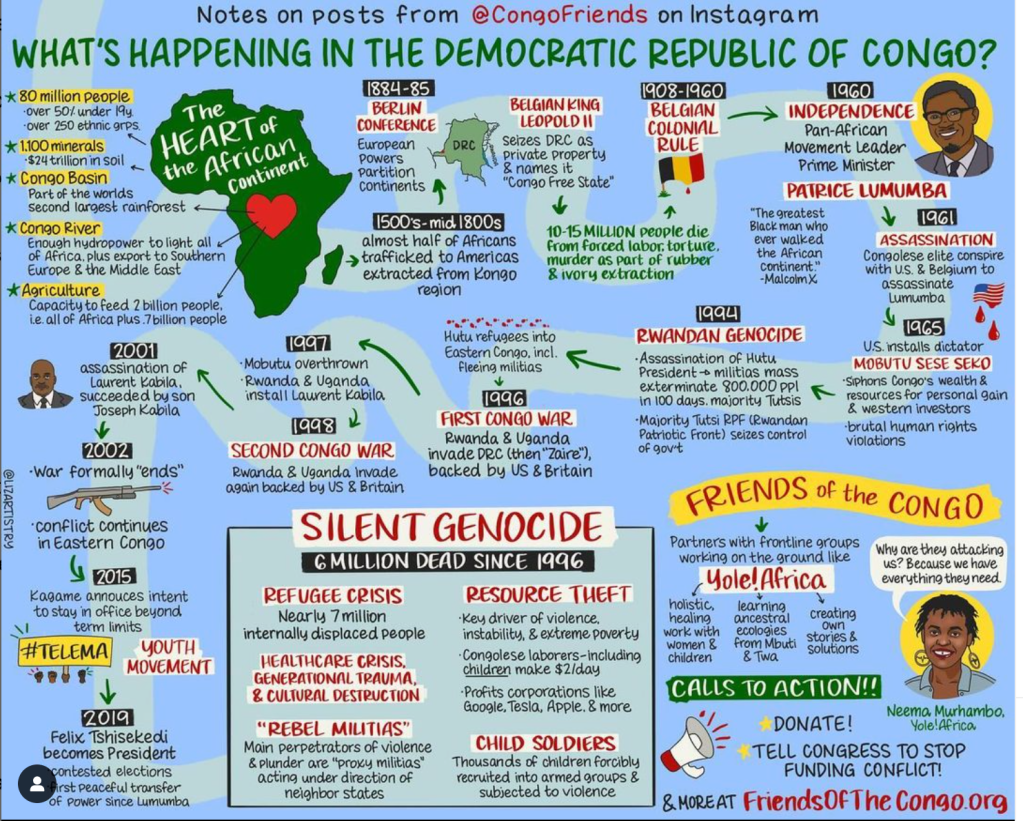
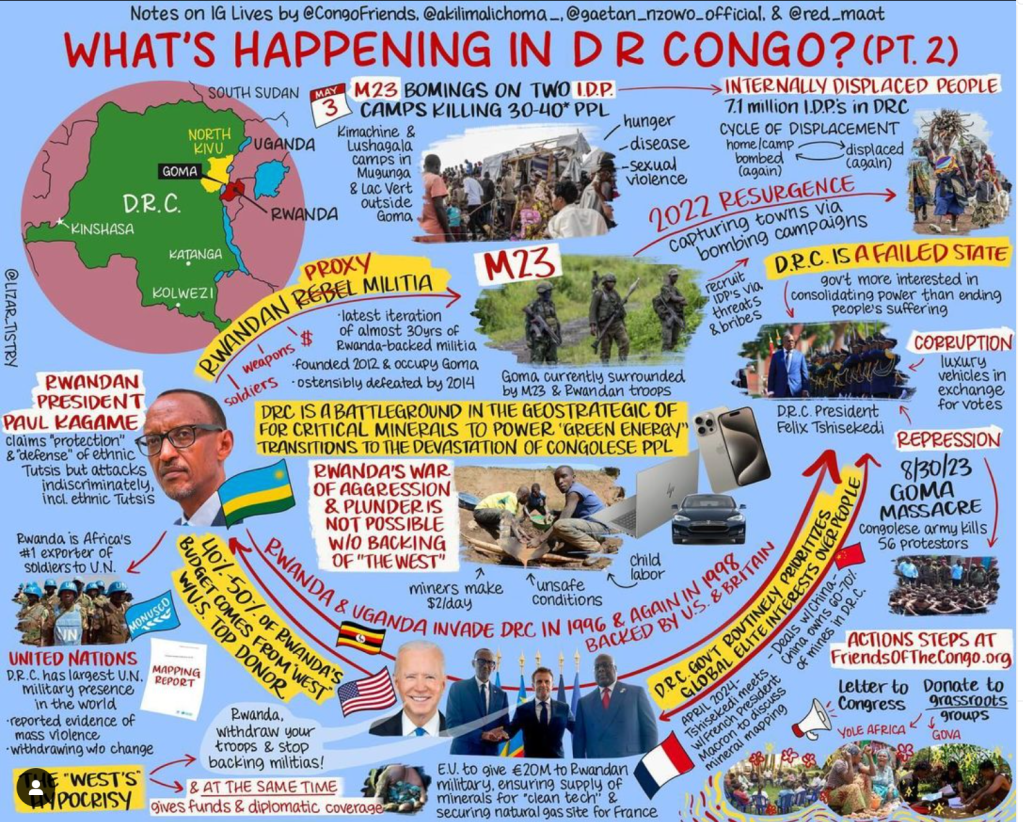
Artwork done for Friends of the Congo by Lizartistry.
Internal Challenges:
1) Corrupt local elite. Corruption is endemic in Congo. This is a huge challenge that is difficult to solve, and affects everything from business investment to humanitarian assistance.
External Challenges:
2) Neighbouring Countries. Since the Second Congo War (also known as the Great Africa War or Africa’s World War) in 1998-2003, and also in part a legacy related to spillover from the Rwandan Genocide in the 90s, Rwanda continues to support proxy rebel militias, who displace local communities en masse and then exploit the local resources and sell them on the international market. For example, Rwanda’s biggest export is gold, but it exports more gold than it mines. Where is this gold coming from? Eastern DRC.
3) Foreign Governments. The USA and the UK are arming and supporting the Rwandan military, but these weapons are going into the hands of the Rwandan-supported militia in Congo. These militias are deliberately and violently displacing civilians in order to access natural reserves that are then exported by the Rwandan government. Furthermore the UK is now paying the Rwandan government millions of dollars to take refugees, despite these concerns and concerns over human rights abuses inside Rwanda.
4) Multilateral Institutions. The World Bank and IMF wrote the mining laws of the Congo. Before the laws were revised in 2022, they were insufficient in protecting the DRCs own interest, and the legal framework enabled multilateral corporations to access resources in shady deals without proper transparency. The inadequacy of the UN to hold nations destabilising the Congo accountable could also come under this heading.
5) Multinational corporations. Multinational corporations continue to violate OECD ethical guidelines, dealing with criminal networks and using bribery and underhand tactics to exploit DRC for mining royalties. In June 2020, a criminal case was launched against Swiss-based corporation Glencore for corruption and its partnering with Dan Gertler, the Israeli business man who has been getting money concessions from the Congolese government. In the courtcase he was exposed for bragging about having ‘control of the Congo’, bribing officials with sums as big as $20 million. He is now under US sanctions but continues to recieve the royalties. In 2002 the UN published a report on illicit trade of minerals from DRC, and listed 85 international companies, many registered in the UK and the US, yet their home countries did not hold them to account.
6) NGO industry / Charity Sector. In 2020 a review commissioned by an UN agency-led taskforce found multiple examples of corruption and fraud in the aid sector in the Congo.
Being Congolese in Turkey
Back to Turkey now and Gloria told me a little about the situation for Congolese refugees here. “What I can say is that refugees in Turkey, they need help. They need people to hear what they are living. They need people to hear their voice. Many of them, they are dying in the house. They have fear of going to the hospital. Part of the reason why we are seeing African refugees trying to cross the Mediterranean/Agean sea into Europe is because they don’t feel accepted as refugees in this country. They don’t”.
“If families do get the papers that grant them asylum there is no support or assistance” she told me. “And often the government will send them far away from the city. But for them to settle in that place and survive they need to find a job. They need to start from zero. And they don’t know anyone who can help them. And from all the testimonies I have from these families they say they couldn’t stay where the government placed them because they can’t find a job or any way to sustain themselves…..So you find people come back to the city where there is more opportunity to find work. Now the issue is that people lose their legal right to stay if they leave the locality that the government placed them in”.
Gloria told me “People who have claimed asylum are required to sign with the authorities twice a week, every week. That also means even if you do get a job, your boss probably can’t allow you to get that much time off. So it’s very difficult. It shows that refugees are limited in many ways. And another thing is while people are trying to work to earn a bit of money they are getting caught by police, and the police are arresting them, taking them to a detention place and then they will be staying there for 6 or 7 months. Without being aware of what is going to happen to them later….And in very difficult conditions. And many people are dying inside of the prison, and no one is hearing about this1“.
Imece’s Current Cases
Gloria’s job is always stressful; and when I’m with her, her phone is often ringing with people asking for emergency help with translation in hospital, or with bureacracy when they are with police or authorities. But recently Gloria’s job has been particularly overwhelming.
Two weeks ago, we had an Imece team meeting, and with tears in her eyes, Gloria told us about some cases which are really affecting her at the moment. I have not used their real names.
1. JJ was extremely ill and eventually admitted to the hospital, where they found he was suffering from lung cancer. During this time, he was unable to attend 2 appointments with the authorities to sign his papers because of his critical health condition. On the week that he was scheduled to start his chemotherapy, he was told his health insurance was no longer valid. The reason cited was because he did not go to sign his papers. Since then Gloria was able to secure him a lawyer to get him the urgent healthcare he needs. But he is now so ill that he needs alot of assistance to get to and from the hospital, and to his appointments to sign with the authorities.
2. Gracie is 5 weeks pregnant. A cyst has been found in her womb. If surgery is not performed to remove it soon, both her life and her unborn babies life will be threatened.
3. Seline has diabetes. While this is usually easily treated, she has been denied access to healthcare because she does not yet have the required legal papers. This has resulted in the extreme situation of her losing her toes and fingers. She is now in critical condition and her life is at risk but this could be so easily treated if we can get her access to healthcare.
Gloria, you are truly a fighter, and your work with Imece has undoubtedly saved lives. I’m so impressed at everything you’ve already achieved. I’m going to miss you when I leave Turkey but we will keep in touch. I want to dedicate this blog post to your mum in Burundi (who incidentally is half Congolese herself). You have told me a lot about her and she sounds like a really strong woman. I can only imagine how hard it is when your children live on different continents. Truly she must be an incredible woman to have raised you, and I am sure she is so proud.
You Can Help!
Click on the button below to see Imece’s fundraiser. Donations will go towards supporting the people above, and others, with access to medical services; as well as supporting essential needs of pregnant women and newborns, and legal support to those being arbitrarily held in detention centers.
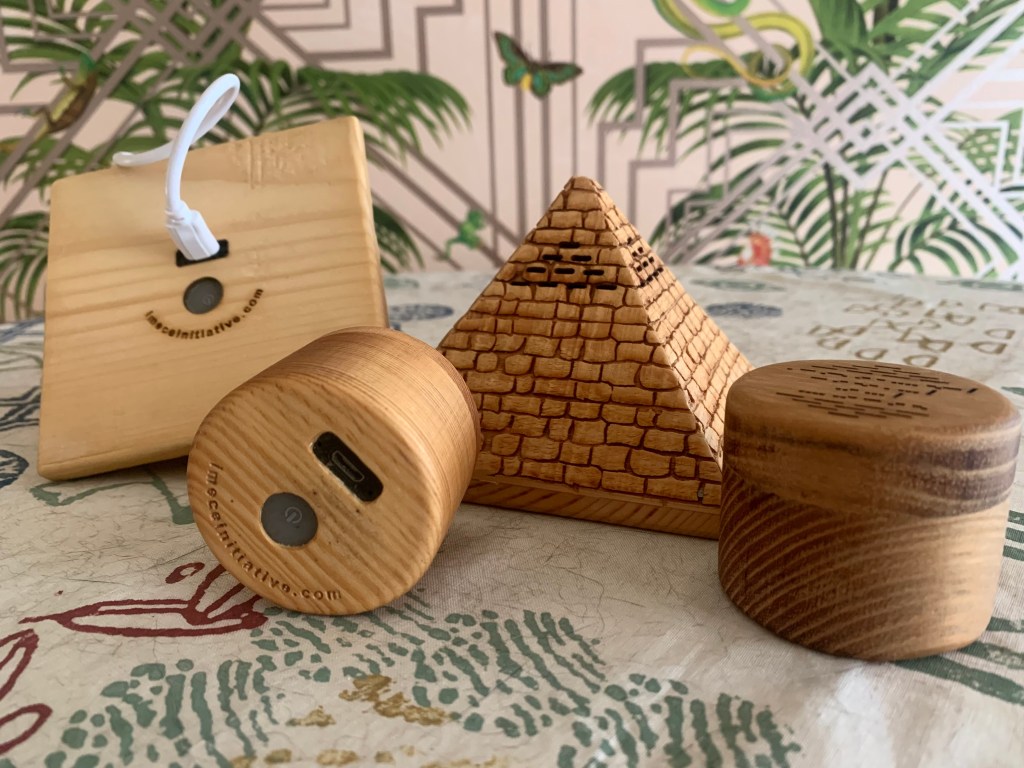
Imece teaches refugee women to make these super smart speakers from scratch! How cool is that? It’s something women can do to get income even if they are pregnant or have small children to care for. I also love the look and the sound quality. If you are interested in buying one for €20 please fill in the form below, but please do NOT disclose your full address at this point, it’s better that we sort this over WhattsApp as it’s more secure.


Friends of the Congo also have many ways that you can get involved and support the Free Congo movement, (both are based in the USA), and Save the Congo is a grass-roots Congolese-led campaign group registered in the UK.
More
A lot of the information in this blog came from the brilliant interview with Congolese human rights activist Kambale Musavuli on The Malcom Effect podcast.
If you haven’t already heard of Patrice Lumumba, please get to know!
“The greatest black man to ever walk the planet”
– Malcom X speaking about Patrice Lumumba
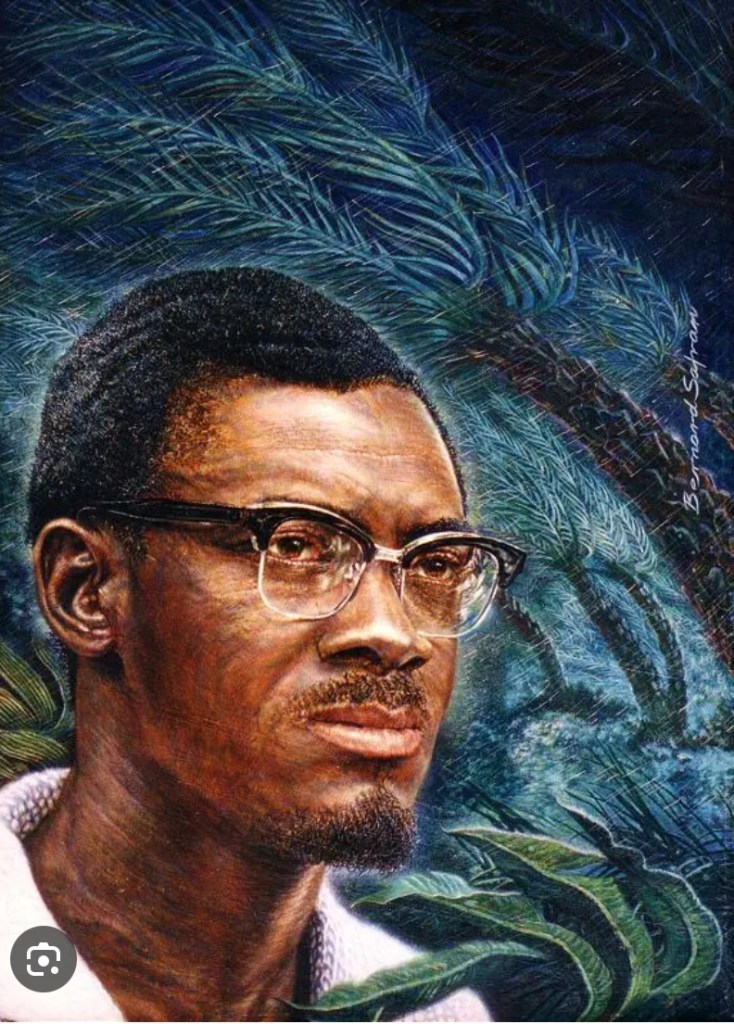
George the Poet tells the story on his multi-award-winning podcast ‘Have you Heard George’s Podcast?’ episodes 29-31. But there are also many books, articles, and documentaries about him.
Thank you so much for reading, please let me know what you think in the comments section, and I’d be so grateful if you like / subscribe 🙂
1 What Gloria told me about refugees dying in prison chimes with what other people told me anecdotally in Turkey, but please note I could not find any official reports or statistics to back up this claim. A human rights report from Amnesty International in 2016 details the failure of the Turkish state to meet basic needs of refugees. A more recent report by Global Detention Project in 2021 details poor conditions in prisons, opaque detention oversight, lack of access to legal help or medical care and one suspicious death.





 The Beirut Bulbul.
Leave a comment