
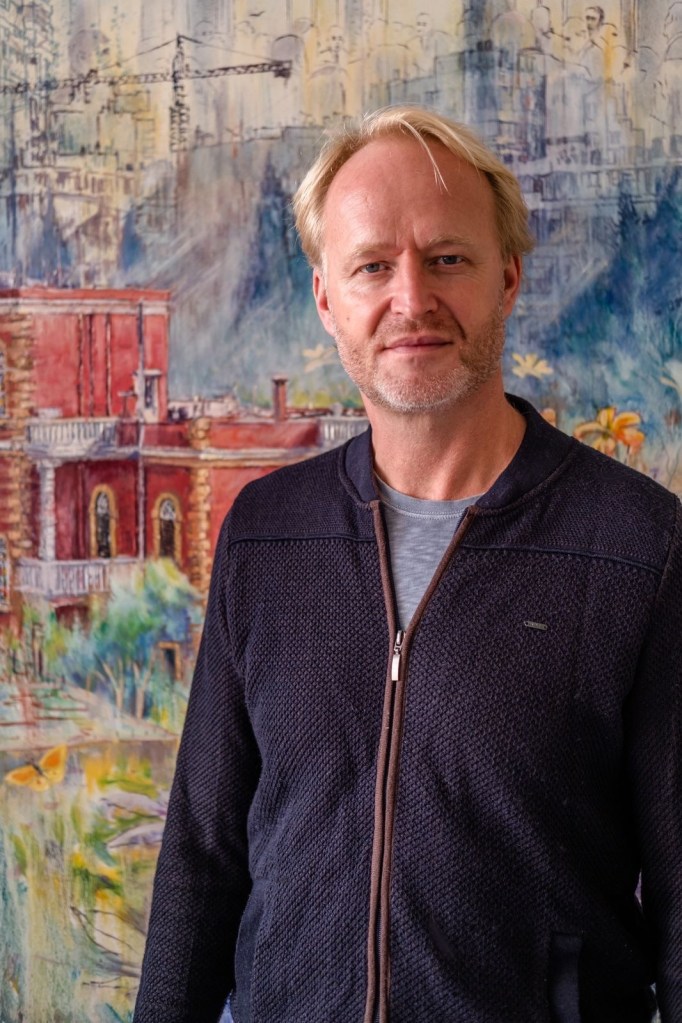
Artist Tom Young is known in Lebanon for his paintings, storytelling, architectural interventions and social activism. Tom is from Britain, but has lived in Lebanon for 15 years now. I met Tom in his beautiful Studio on Gouraud Street in Gemmayzeh, Beirut. It was a warm Friday in April, and the sunlight streamed in through the tall triple arched windows. The studio was illuminated with colour. Tom told me about his upcoming exhibition in London, BE/Longing II, and gave me exclusive access to some of the paintings which will be on display in the Marie Jose Gallery in Kensington, Victoria road. It will run for 2 weeks from 14 May – 1 June 2024.
It is the second exhibition in the series, with the majority of BE/Longing I still up in his gallery in Gemmayzeh. It will reopen to the public in the first week of July 2024 for ‘Beirut Art Days’ when he is back from London. His exhibition ‘Revival’ is also ongoing at Hammam Al Jadeed, in Saida, southern Lebanon, soon entering its fourth anniversary.
“Let there be spaces in your togetherness,
And let the winds of the heavens dance
between you.
Love one another, but make not a bond
of love: Let it rather be a moving sea
between the shores of your souls.’
– Khalil Gibran
(quoted in the Belonging II Exhibition booklet)
BE/Longing II is in many ways quite a personal and autobiographical collection, and focusses on connections. Connections between East and West, between Beirut and London, between history and the present, destruction and revival, between the personal and the collective.
BE/Longing II
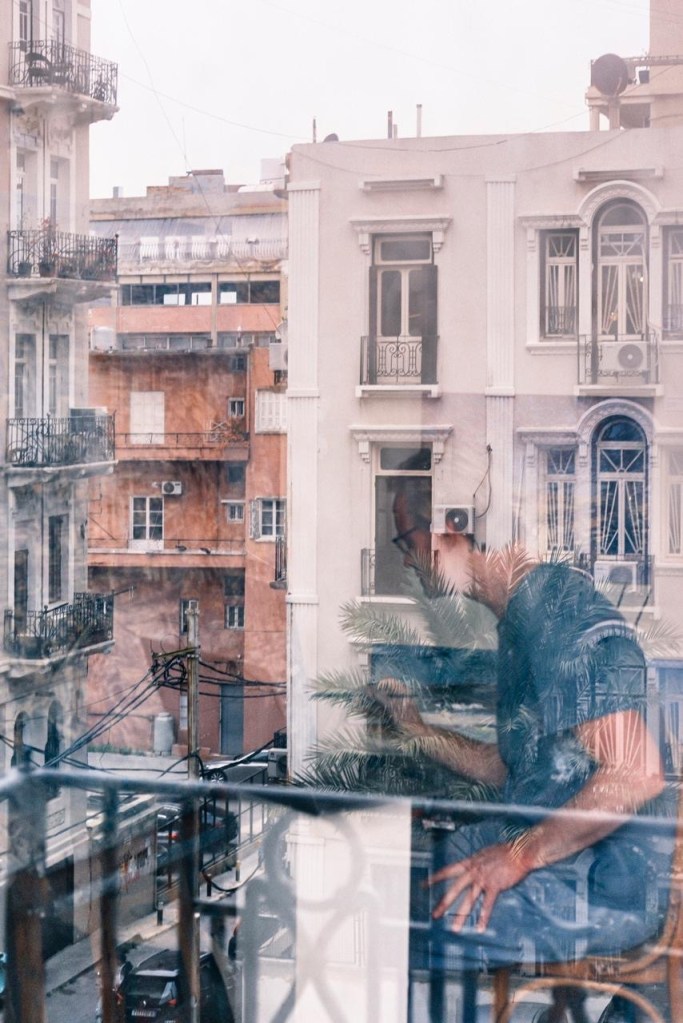
“I called my exhibition BE/Longing because it has a sense of identity through place. I’m interested in the exploration of memory and hidden stories, these magical stories that live on in these amazing old buildings in Beirut. And many of them have been forgotten. So I explore how we find this sense of belonging and identity through stories and memories. And in the exhibition you’ll see I’ve painted certain buildings and iconic places that have hosted major events in Lebanese history.
But also from a philosophical point of view, the word belonging interests me in itself. We are longing for peace, stability and justice; as we long for a sense of connection to our past, a percieved identity, to each other. Yet if we can truly be, in the truest sense; then we are not longing for anything, because we are already complete.
So in some sense it’s as much an exploration of this sort of connection and union between external and internal, as much as it is about the past and the present. Or in this case for the exhibition, East and West. And in Lebanon you always have this paradoxical combination between joy and pain. Almost always, on every street corner, in every building, in every story theres always an element of the two, that are coexisting. So the coexistence of opposites, it’s something that really interests me culturally and geographically.

I’m also interested in the work of neuro-scientist and philosopher Dr. Iain McGilchrist whose work is about the divided brain; and the idea of the different brain hemispheres, left and right. One is more exacting and likes order, and the other is more kinesthetic, more emotional. I’m interested in how the two work together, even slightly against each other sometimes”.
Revival
“I opened up my gallery here over Christmas and New Year to the public, and my gallery here in Beirut is in a building which itself was badly damaged in the port explosion in 2020 August 4th. My previous studio was also destroyed, it was next to the hospital in Geitawi.
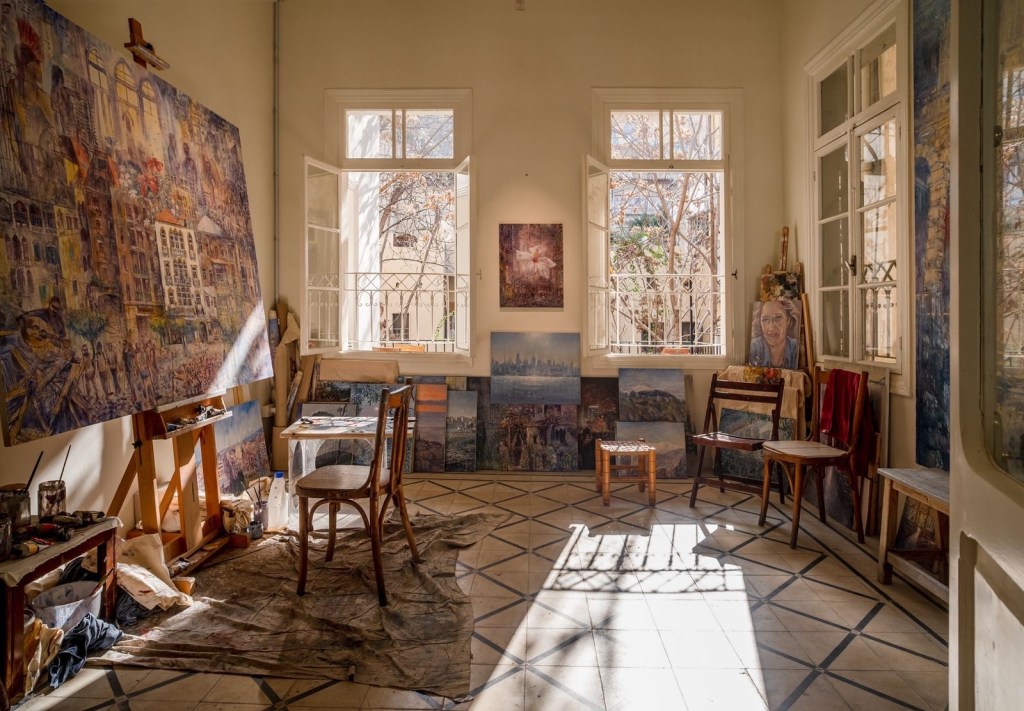
So I wanted my new studio to be in the area that was damaged the most; to be part of the cultural revival. The idea of breathing new life into damaged or deserted buildings is an overarching concept of many of my projects.
From Hamam Al Jadeed in Saida that I currently still have an exhibition in at the moment, to many other projects like the Rose House, which features in some of the paintings that are going to London in Manara; Grand Sofar Hotel in the mountains; Villa Paradiso, where I discovered the belongings of an Armenian family who had fled the civil war in the late 70s. So many of these buildings have provided a meaningful context for my work. And many of these stories appear in the exhibition here in Beirut”.
Anglo-Lebanese Connection
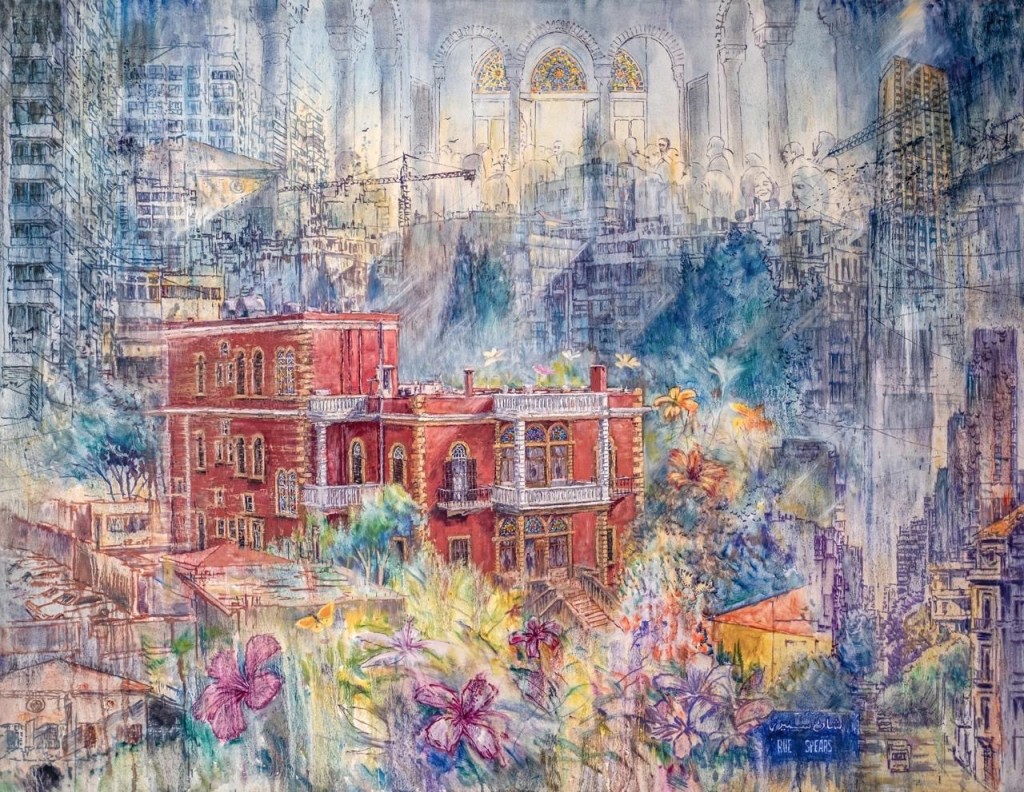
“This painting is of the former British Ambassadors residence, which is now the administration center for the Dar Al Aytam Al Islamiya orphanage institution. {Tom taught painting to the children there for six months and they did a collective exhibition on the house in 2017}.
This building really embodies the historic Anglo-Lebanese connection. Its most famous resident was the British General Spears who is a very interesting character. His wife Lady Spears (née Mary Borden) was a suffragette womens rights activist who was a fascinating woman in her own right. She was a poet, and a painter, – she painted Lebanon in the 40s. She did a lot of humanitarian work, and set up hospitals for poor villages in Mount Lebanon.
Her husband, General Spears was controversial and unorthodox. Whilst he was part of a damaging colonial system, he ‘ganged up’ with the Lebanese Independence movement, and he played an important and pivotal role in Lebanon gaining its “independence” in 1943.
After Lebanon got it’s independence, he was fired from his job for his very unorthodox techniques, because he angered the French so much. What he did threatened the whole basis for colonialism. Lebanon was the first Arab country to get its independence. So for a colonial General to basically be ganging up with and supporting a local independence movement was seen as dangerous at the time. And Churchill told him, “We should discourage the throwing of stones since we have greenhouses of our own – acres and acres of them”.
“We should discourage the throwing of stones since we have greenhouses of our own – acres and acres of them”
– Winston Churchill (in his letter to Spears)1
Both the Spears were anti-Zionist. They could see that it was going to be an absolute tragedy for the Palestinians. And it was going to cause a lot of violence and conflict for the region. So they went out of their way to criticise what they saw as a very damaging policy. And a lot of what they wrote about at the time is now coming true. So they predicted what’s happening. Lady Spears set up the Anglo-Arab Relief Fund for Palestinian refugees in the late 40s, and she said at the time “what we are seeing from our comfortable distance is a tragedy which is going to affect the history of the world”.
“The troubled story of Palestine is not finished. What we are watching from our comfortable distance, is not the end but the beginning of a tragedy that is going to affect the history of the world”
– Mary Borden (Lady Spears)2
So, they were interesting for me because in some ways they were very establishment, but in other ways they were very anti-establishment; they were controversial, maverick people who didn’t follow the line”.
Reflections on the Present
“Today, you look around at what’s going on in the world and you only wish that someone in a high position would have the guts to actually stand up for what’s right. That someone with the tenacity and bravery that the Spears seemed to have; this is what we need now and it’s what seems to be missing at the moment. There seems to be a total lack of leadership or any sense of humanity. I call it a Genocide. I can’t see any other way of describing it. When you see what’s actually going on… And I think anybody who is providing support for it, or diplomatic cover for it…as an individual human being I will not support this. I can’t stand by and say nothing. I’m not part of the political order or the diplomatic chain so my influence is limited, but I’m an artist and a painter, so I can make art about it. I think we can all play our part.
I still really believe in the values I grew up with in the UK. The rule of law, the decency and fairness and kindness of ordinary people in Britain. These are the values I grew up with, and I do believe in that, even though I don’t see that in the political leadership. You know, an independent judiciary, a free health service, trial by jury, human rights, freedom of expression, ….fantastic music and art scene in the UK….You know I do believe in them, and in fact some of the paintings in this exhibition are referencing that”.
Carnival (Notting Hill)
“One of the paintings I’m exhibiting is of the Notting Hill Carnival.
Growing up, my older brother and sister lived in Notting Hill so I used to go to the Notting Hill Carnival quite often, and I witnessed all of this incredible colour. All of these different cultures coming together (largely) peacefully – I love that about London and where I’m from. I feel Carnival represents a sense of free expression, joy, dancing and music. It’s also where I lived for many years in London and it’s where my journey to Lebanon began.
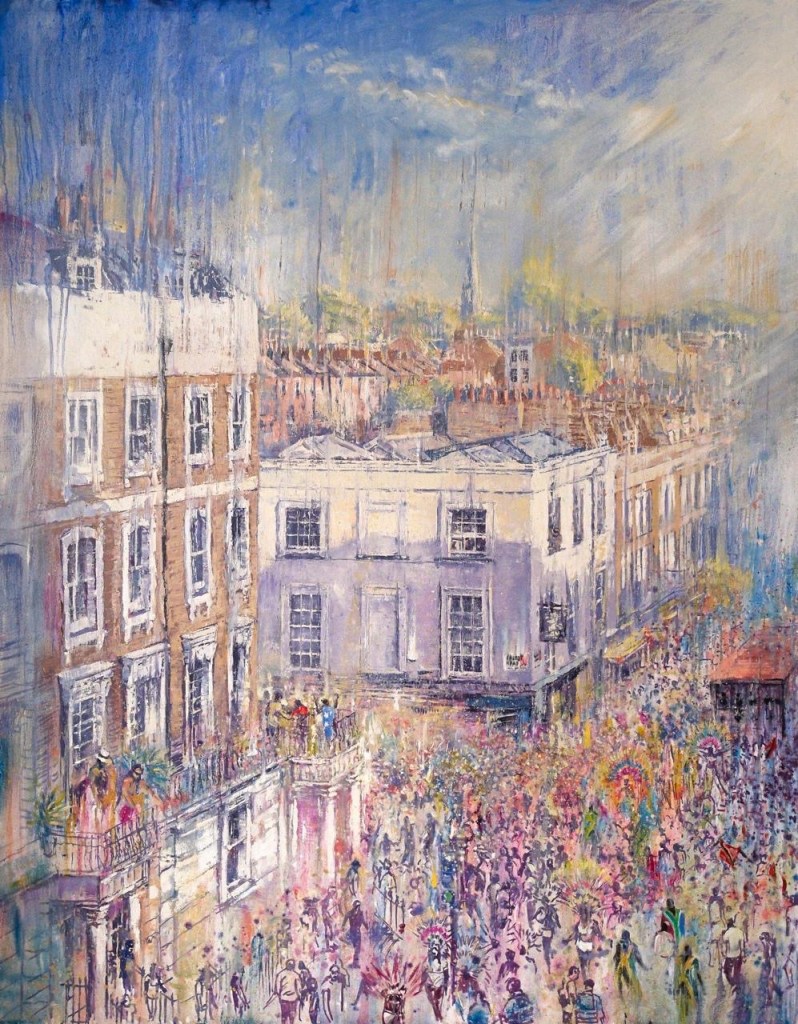
When I was living in Notting Hill, I had a garage next to a Lebanese car mechanic, and funnily enough, Lucian Freud the great painter also had his garage in the same place (it was under my bedroom window)! I met Lucian Freud and he saw my work and he liked it; but curiously it was actually Lebanese car mechanic Raed Zahreddine who had a greater influence on my career. Raed commissioned me to come to Lebanon in 2006 (just before the war), to paint pictures of his home village because he missed it. So my first trip to Lebanon was all about one mans sense of belonging. And the sense that he loved his life in London but he longed for his homeland.
And so, that essence has always been part of my work. Definitely in Lebanon, that sort of sense of belonging that comes from dispossession and exile and it’s a desire for something that perhaps isn’t here but its over there. And that’s also quite a human state. I’ve also tried to express this state in the technique of the paint. When the paint is still wet I wipe it up. So its as if its shifting, nothing is permanent. And theres something slightly ephemeral, as if you’re living in an illusion, which is always just beyond our grasp.
The painting of Notting Hill means a lot to me, and its also where my brother still lives, and my sister used to live for many years, – she passed away 5 years ago. So in a way I’m also thinking of her.
Talking about multi-cultural and people coming together, you can also see the flags in the painting of Jamaica, Trinidad, Brazil, and South Africa. And the South African flag is a reference to the seminal ICJ court case. Another link is that I went to the Notting Hill Carnival last year with my Lebanese girlfriend who is part South African”.
Festival (Gemmayzeh)
“This painting of Gemmayze is the companion piece to the Carnival painting. I wanted to make the connection – you know Lebanon has a famous party scene, as does London.
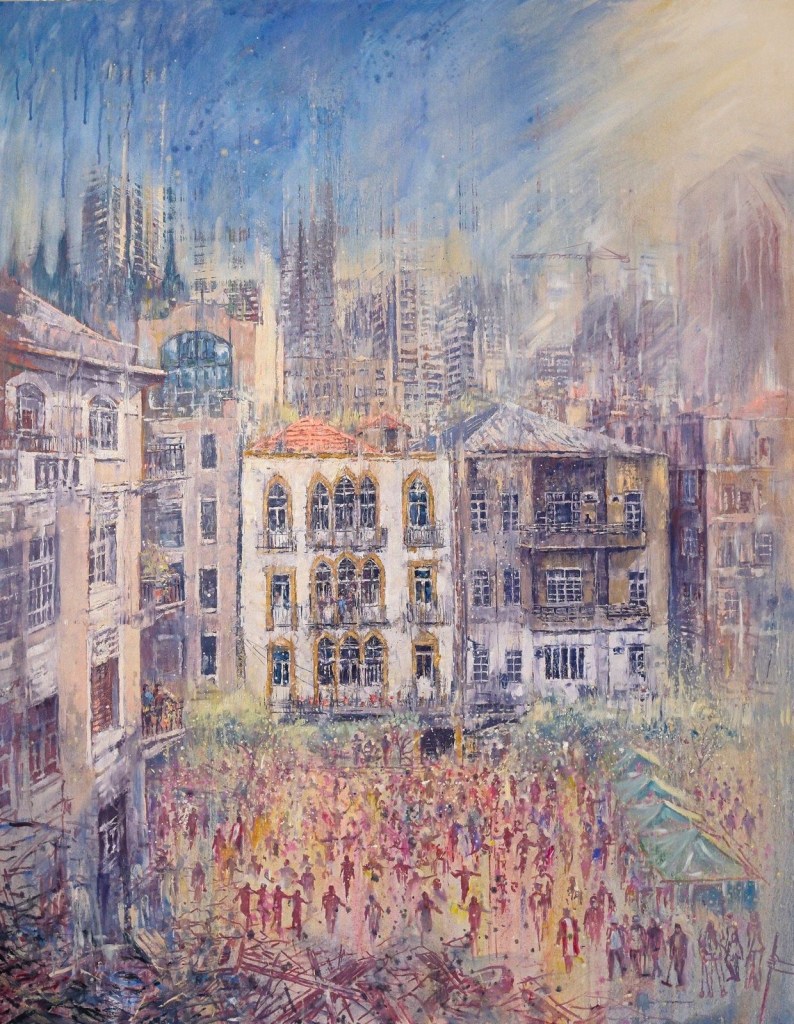
It’s a painting about the music festival that took place last year when I opened the studio. The balcony of my art studio was the venue for Lebanons most famous pop stars. They were all singing here from the balcony to thousands of people below. It was the first major big public event since the explosion in 2020. I’ve paid respect to the explosion with the debris and destruction at the bottom of the painting. Then there is a sense of revival as people are coming together.
I’m a bit reluctant to use the word ‘resilient’ because I think it’s overused, and I think the Lebanese are sick of being called resilient, and having to be resilient. But nevertheless, its courage, and strength. Courage is active, resilience is reactive. Resilience is forced upon you.
And then theres again the sense of things rising. Perhaps the spirit rising, up the sky.”
Double Standard
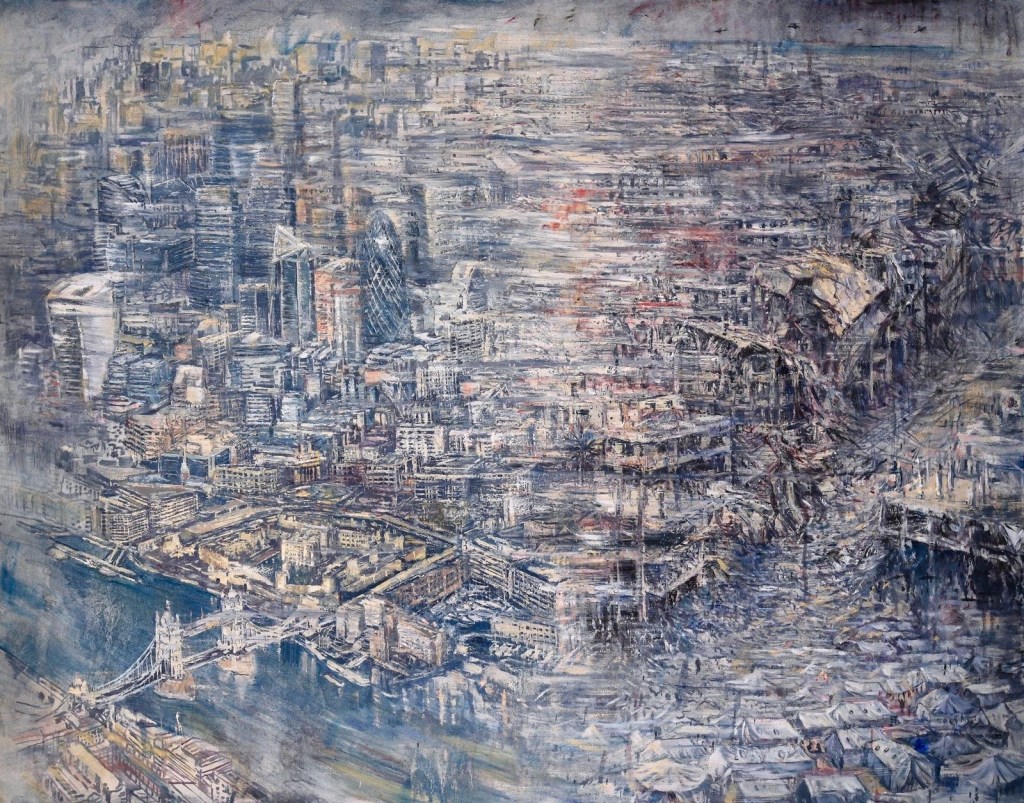
“This is a tough painting. More confronting. This is perhaps the only one in the exhibition in London that really deals with the situation in Palestine head on.
On the left you have the business district of the city of London, where all the money is made, laundered, invested…you know it’s where the money flows. And then on the right of the painting you have that merging into the destruction in Gaza, and the refugee tents in Rafah. I actually have a friend in Gaza at the moment who’s sending me updates and photographs. So some of the imagery in this painting is from my friend. And the imagery of the city of London is taken from photographs by my Lebanese friend in London.
I’m not necessarily telling people what the painting is about, but there’s a clear link between business, and war. And weapons dealing, arms manufacturing. Which seems to be what is driving all of this; the need for business, and profit, and as long as the money is flowing, the shareholders have got to be pleased with the profits, and for the arms business to be doing well then wars have to happen… It’s totally immoral.
The painting is called ‘Double Standard’ in clear reference to what we see going on. All this talk of human rights and democracy….I support talk about human rights, but it’s not reflected at all. And it’s so sad because I think the things we believe in are right, you know, the rule of law, human rights, but for all not just for some. But it does seem that human rights…it’s very clear that human rights are conditional. And the definition of power, well power can be defined by ones ability to escape the law. And so, the definition of power seems to be impunity.
And it’s so sad, because I really believed, …I still really believe in the values that I grew up with, that I perceived. But again having read a lot of history, I’m very well aware of the history of the British and the French having created this situation in the first place, you know the Balfour Declaration as we all know, the Sykes-Picot Agreement. So you could read this painting in its historical context too. And it’s…we’ll see how this goes. I could have done a lot more paintings about this subject. But…the gallerist also felt that one is enough. And perhaps one will make a stronger impact, if the rest of the paintings are more uplifting”.
Disoriented
{I asked Tom how painting ‘Double Standard’ made him feel}
“Well, I feel sad. I guess deep down I’m so disturbed and so angry about what’s happening. It’s by far the most upsetting and distressing event in my lifetime.
“Deep down I’m so disturbed and so angry about what’s happening. It’s by far the most upsetting and distressing event in my lifetime. It’s utterly disorienting. Because we don’t know who we are anymore or what we believe in.”
– Tom Young, on the indescriminate destruction of Gaza
It’s utterly disorienting. Because we don’t know who we are anymore, we don’t know what we believe in. You just see nothing but lies. And the media complicity…there just doesn’t seem to be any sort of safe ground anymore. And I feel almost on an ethical level, more comfortable living in Lebanon than I do anywhere in the West, because of the complicity. And the double standards, and … well the complacency, and kind of sheer ignorance. And a lot of people in the West you know they’re just fed diets of nonsense by the mainstream media which is completely biased. There is very very little fair reporting, that I can see the on news channels. And…. What do I feel? I feel sad.
They’re very emotional paintings to make. Because I go through, it’s as if you have to go through the pain and the sadness to make the painting. You have to feel it 100% otherwise you’re just not doing it right. You’ve got to put all of your soul into it. You go through it with your heart, and it’s not so much to do with your brain and your intellect I feel, it’s definitely dictated by the heart. But at the same time it’s technically quite difficult to make and so you’ve got to be quite disciplined in the technical sense. And maybe disciplining oneself in a technical sense is a way to channel the emotions, and possibly disassociate slightly, but at the same time feel it”.

Therapy Through Art
“Our brains are just not designed to cope with such extreme trauma and suffering. And [painting], it’s like a sort of therapy actually. I do teach art therapy to kids and refugees, but also a lot of my art is like therapy for myself. And that’s where it has to begin. It’s a way to cope. Because just look at social media and look at the news and it’s just too ghastly for words. And you just…. So yeah I’m trying to do something with it. Share, even just express some solidarity with my friends in the region. And hopefully artistically provide some contribution to the fight against this, or some sort of cultural resistance against what is happening.
“Sometimes, in the past 6 months, I’ve found the trauma to be so intense that I can’t actually paint”
– Tom Young
I’d like to make connections, for my art to be part of that conversation and change. Also, with my Jewish friends in London, many of whom are totally against what’s happening. It’s such a tragedy for Jewish people around the world.
Sometimes, in the past 6 months, I’ve found the trauma to be so intense that I can’t actually paint. You know if you look at the news too much then it just diminishes the ability to actually do anything creative at all. Because it’s utterly crippling to lose ones sense of self in this way, but those little periods of time when I can get myself together and really focus. And do some meditation and some breathe work, some yoga, when I get a chance to do some hiking in the beautiful mountains in mount Lebanon, to really gather the energy… I do some painting”.
More…
Tom, your ability to traverse different worlds and hold space for the complexity of multiple and sometimes opposing narratives and realities is an artistry in itself. In a time of trauma, your message of focus on connections and bridging boundaries is vital.


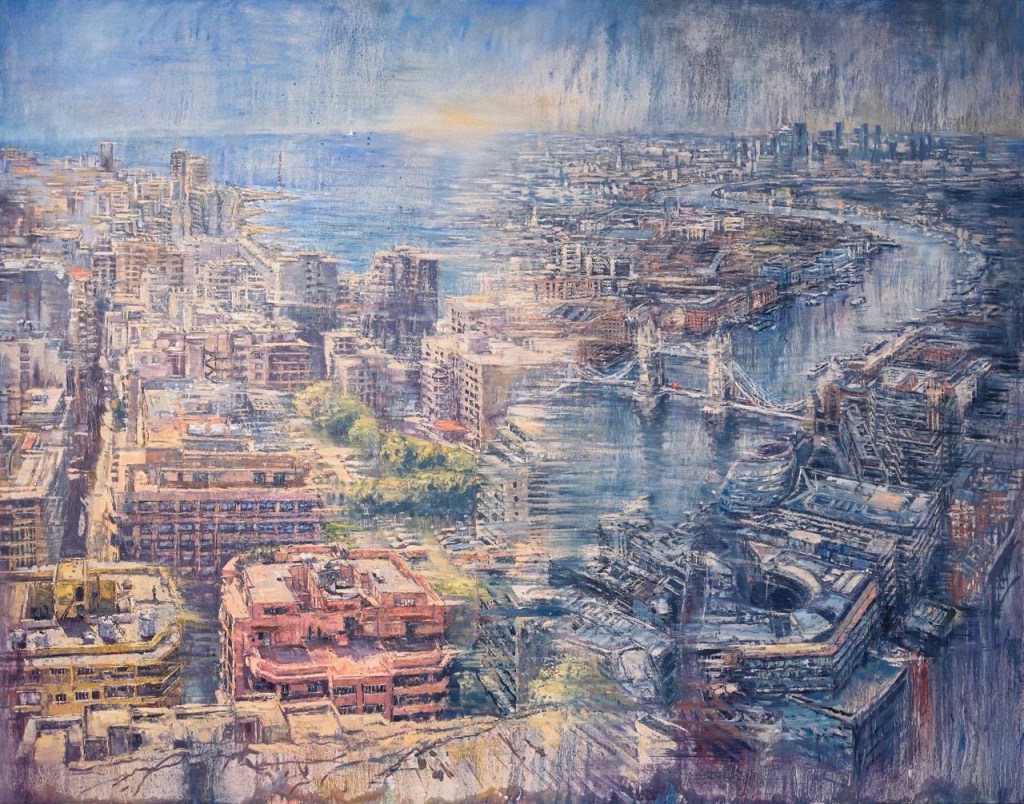
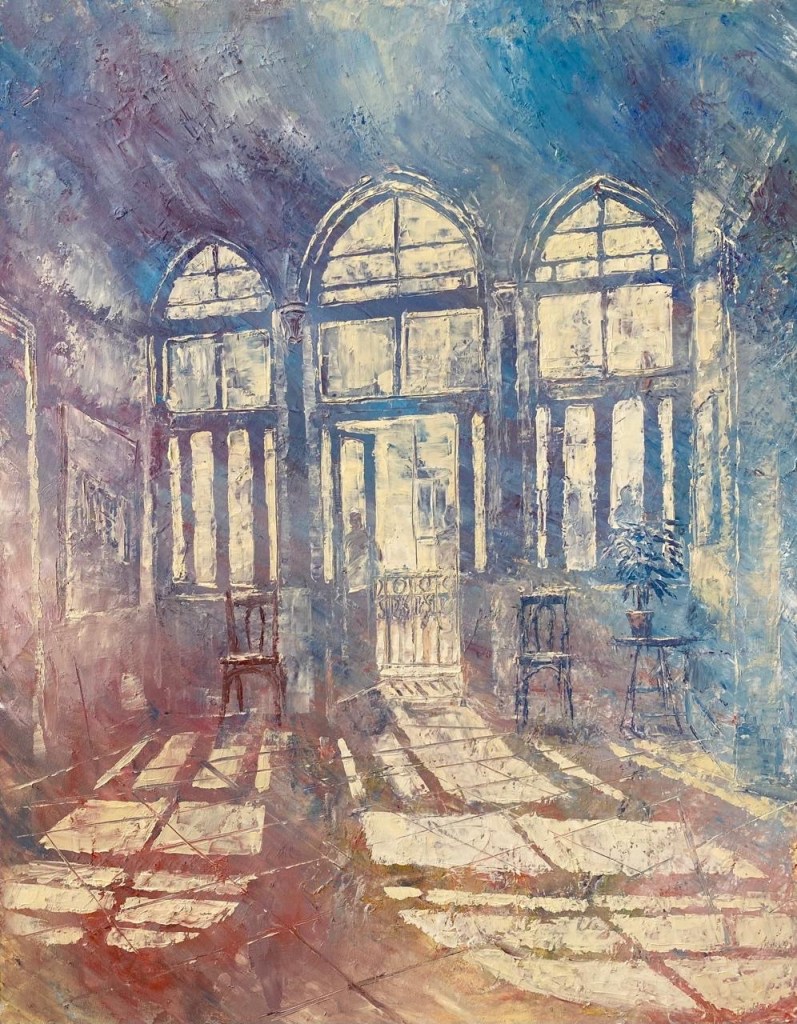
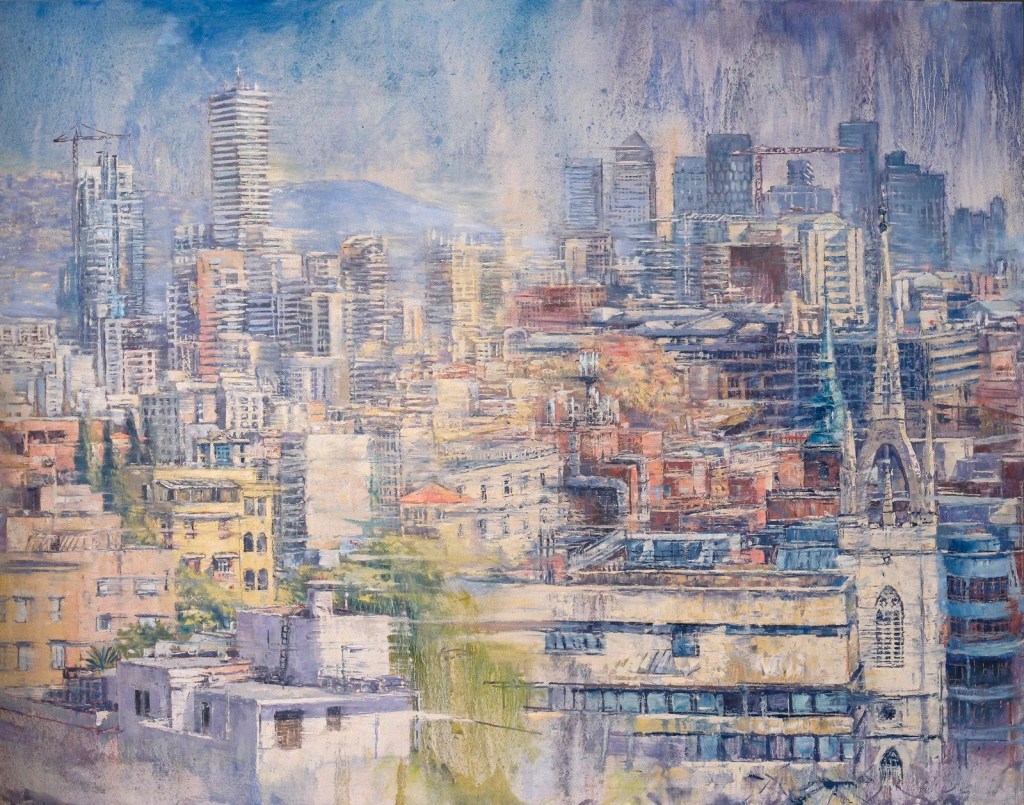
See these paintings and many more, including of the Rose House, the Qadisha Valley, and of the Pennines, in the Marie José Gallery in Kensington, Victoria road from 14 May – 1 June 2024.
Follow…
Visit Tom Young’s YouTube channel for more videos and beautiful projects:
Visit Tom Young’s website here and follow Tom Young on:
The beautiful photography of Tom, his gallery and him painting were all taken by Lebanese Photographer Karim Sakr. Follow him on Instragram @beirut_streets:
Al Jazeera documentary about the Lebanese Civil War, featuring Tom Young:
And finally, please subcribe to this blog and like / share!
Thank you for reading.
- Quoted in Patrick Seale: ‘The Struggle for Arab Independence- Riad Al Solh and the makers of the Modern Middle East’ Page 442 ↩︎
- ‘Mary Borden (Lady Spears) never showed any anti-Semitic views, but had strong humanitarian views about what was happening in Palestine- in 1948 she was involved in setting up the Angle-Arab Relief Fund to help Palestinian refugees. In a strongly worded letter of appeal, she warned that ’the troubled story of Palestine is not finished. What we are watching from our comfortable distance, is not the end, but the beginning of a tragedy that is going to affect the history of the world.’
Quoted in Jane Conway, :A Woman of Two Wars’ ↩︎






 The Beirut Bulbul.
Leave a comment