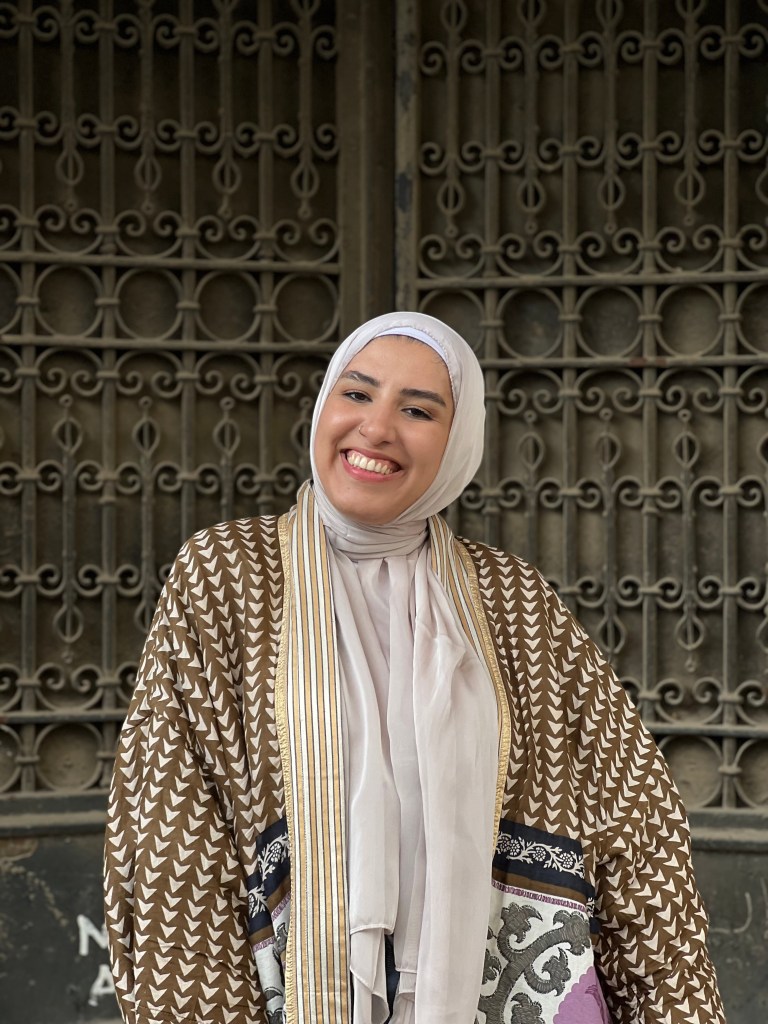
I’m so excited to be back in Beirut, and even more excited to share my conversation with Samira, a heritage activist and the woman behind the brilliant Layers of Lebanon. Samira and I actually met up to chat for this blog piece at the end of April, the week before I went to Turkey for 6 weeks to volunteer. I remember that week. The shadow of the 7th October and the atrocities that continue to be carried out in Gaza feel very close here in Lebanon. The ripples are big here. Fighting continues to displace many on Lebanon’s southern border. I remember that everybody I caught up with that week, from various different walks of life, had a very heavy heart. It’s like a thick dark cloud of worry and tension was engulfing peoples lives. So when I had this chat with Samira, the positivity and curiosity she radiates was all the more inspiring. I walked home feeling energised and with a spring in my step. I hope you enjoy hearing from Samira as much as I did.
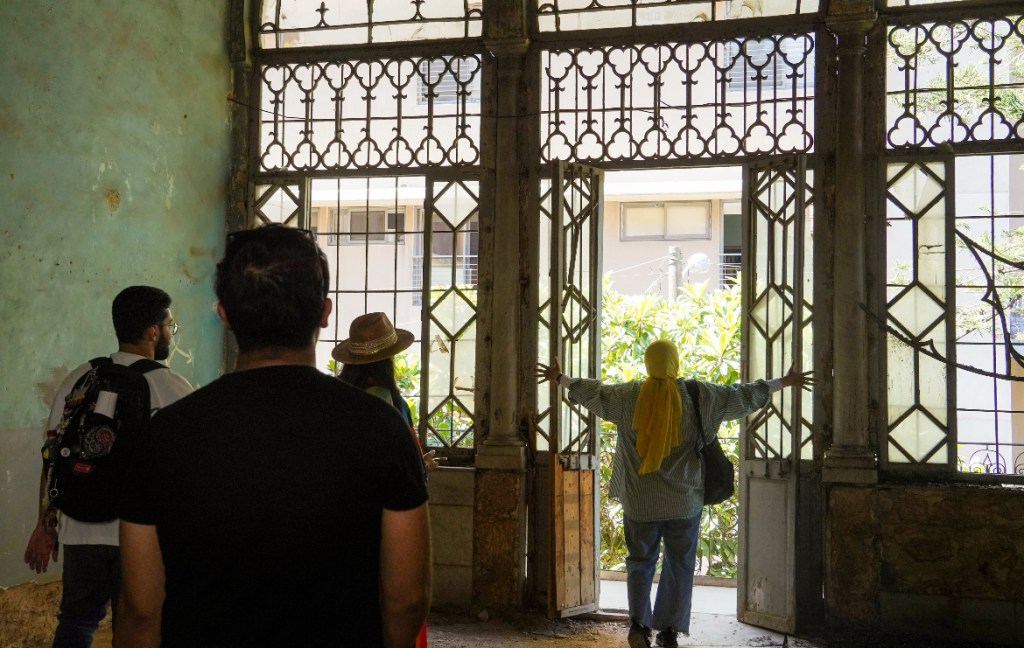
Nurturing Curiosity
My first question to Samira was what inspired her to start Layers of Lebanon, and her walking tour of Beirut’s ‘green line’ – the line that divided east and west Beirut in the 1975-90 civil war11. The tour not only provokes thought and educates about the war, but it is also about life beyond the green line; and Samira skillfully weaves Lebanon’s rich culture, politics, archeology, art, history and food all into one eclectic, fascinating, and thoroughly enjoyable tour. It is a tour that simultaneously remembers the darkest of times in Lebanon, whilst also celebrating Lebanon’s beauty, diversity, and rich cultural heritage.
Samira told me, “I was raised in a household where my father especially, focussed on making sure we go out and discover areas all over. And he always had this tour guide within himself too in some ways, because he’s always like “put your phones away! look at this valley, look at that river, look at that sea! Look at that…” He’s always been like that. He’s a good storyteller, and my grandma (his mother) is a good storyteller as well. We grew up listening to her stories when we were kids, and we grew up just listening to her in awe”.
Family History
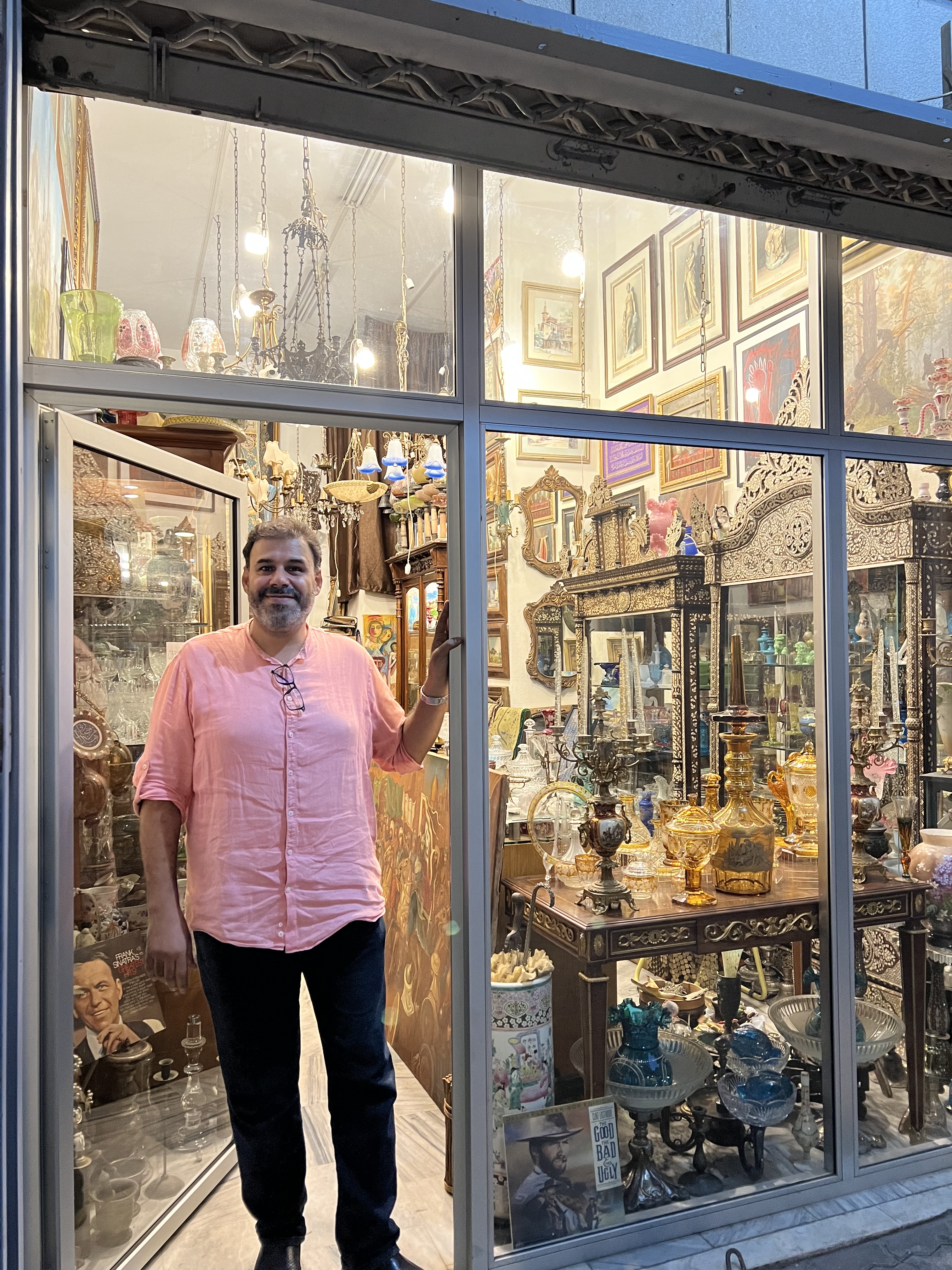
Samira was undoubtedly also influenced by her teenage years spent in her fathers antique shop, ‘Ezzo for Antiques’, in Beirut’s antique district, Basta Tahta. Immersed in this world of antiques and vintage trading, she used to listen to her fathers conversations with clients and other traders and got to know the ‘traders language’, “which is quite a different communication style” she told me.
Over the past few years, Samira’s maternal grandpa has also been sharing his pre-1975 memories of Beirut, especially Downtown Beirut or ‘Al Balad’ as he refers to it (literally translated as ‘the country’ in Arabic). Samira told me she puts her “grandpas stories on as eye-glasses” whenever she takes a walk in a Downtown that today bears little resemblance to it’s former self. Once an eclectic, gritty, bustling heart of the city, real estate company Solidere controversially rebuilt the neighbourhood into an expensive luxury district that few can afford, after it was destroyed in the 1975-1990 war. Many have accused Solidere of ‘erasing it’s memory’, so it’s meaningful that Samira and her grandpa are working to keep these memories alive.
Al Zajal
“My household also nurtured good speech skills” Samira told me. “On my fathers paternal side they are actually known for being improvised kind of poets. We call it ‘Zajal’. Zajal, is listed as an intangible heritage for Lebanon by UNESCO. So they are quite known for that as well in my dad’s family, and his mums side is from Damascus so she also grew up around a strong storytelling tradition”.
Hidden Gems
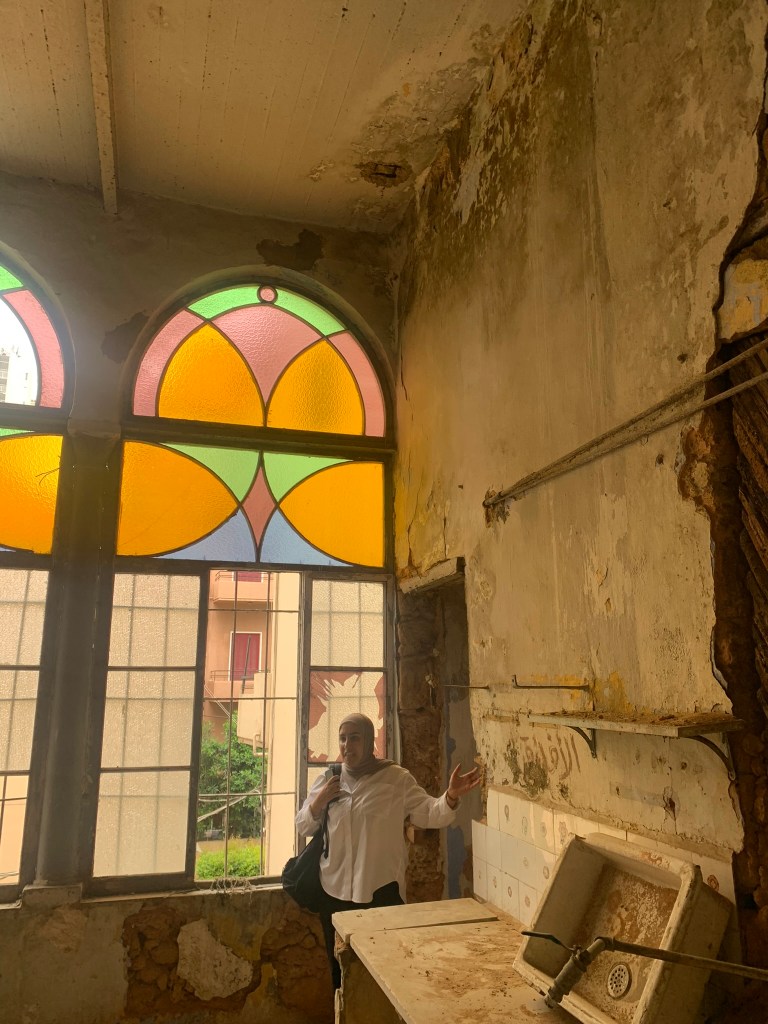
“So it’s a mix of being nurtured in such a household, and then, I studied literature and I always read a lot of books, ever since I was a little kid” Samira explained. “And mainly it came also when I was in university and I started roaming the streets randomly, just like whenever I feel down I started roaming the streets with no destination and this is when you discover hidden gems. You don’t have a destination you’re just walking, for the sake of it. So that’s how it started… taking pictures of heritage houses, abandoned houses, ‘urbexing’…”
From Librarian to Tour Guide
After Samira graduated with her English Literature degree she became an English teacher, and then… a Librarian! Continuing the family tradition of keeping storytelling alive, she worked in a school Library for 3 years as a ‘Learning Resource Center Coordinator’. Her role was a lot more than just looking after the books. “I was in charge of spreading literacy in school: getting kids to go to the library in their recess and read. I organised events and writing contests, and designed tailored targeting of different age-groups all over the school” . She also did research skills training workshops for teachers, supporting them to embed research skills into lessons for subjects such as biology, chemistry.
During this time Samira went on a walking tour of Beirut, put on by a commercial agency. Samira instantly struck up an acquaintance with her tour guide – sharing her own insights of hidden gems she’d discovered, and they kept in touch. It wasn’t long before the two of them came up with the idea that Samira could create her own tour for the agency. And so ‘The Green Line Walking Tour’ was born. In her final year of being a head librarian, Samira was working full-time Monday-Friday in the school library, and giving the walking tour on Sundays. It was hard work! But Samira was passionate about it. Then after 2019, when Lebanon’s economy unravelled, and the currency lost 95% of it value, Samira had a difficult choice to make. Her wage at the school had been $1000 a month, but became the equivalent of just $150 with the inflation. After some time, she made the very difficult choice to leave, and to throw herself into the walking tour, and began to create something bigger: Layers of Lebanon, storytelling narratives of cities through guided tours.
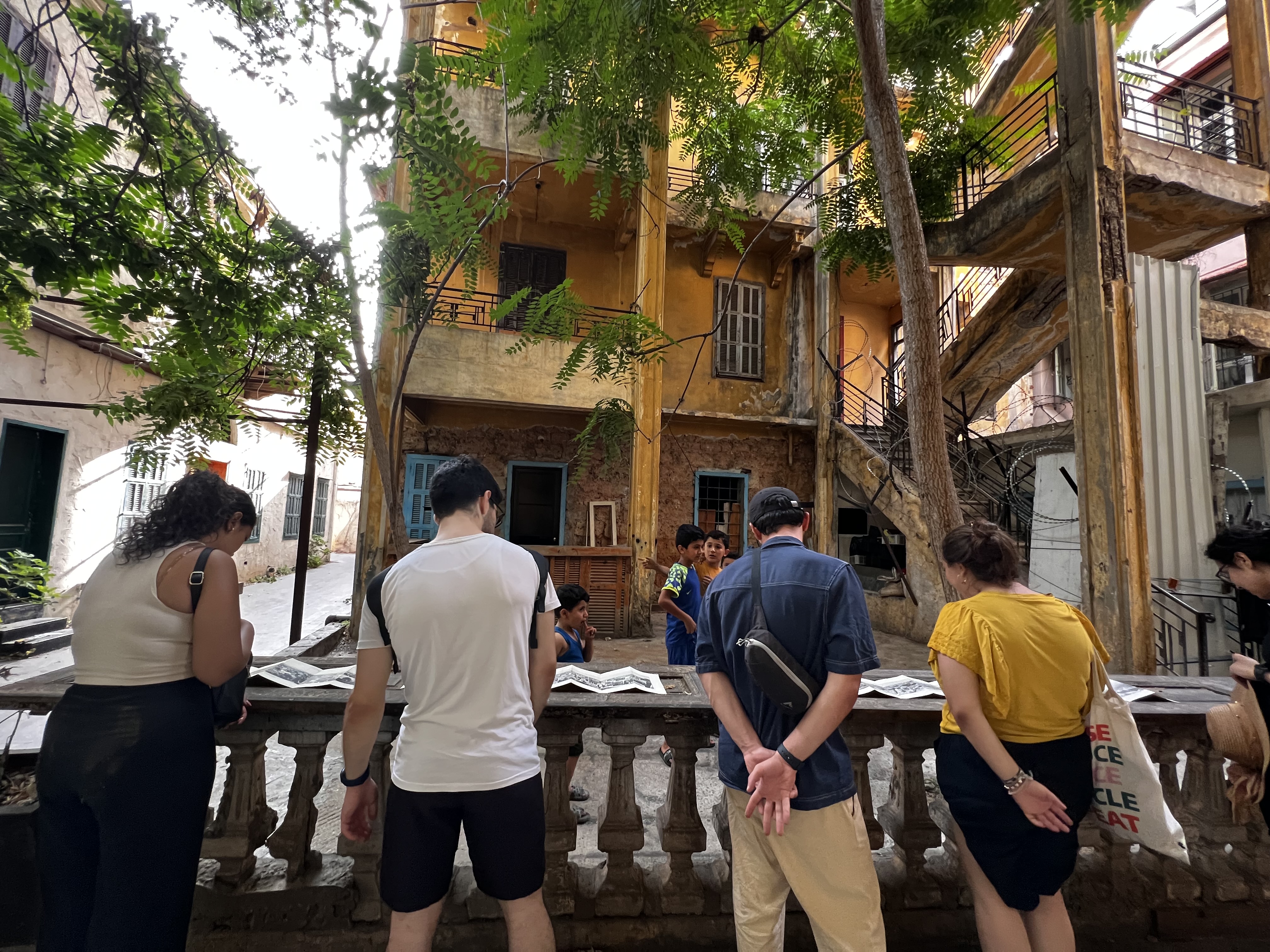
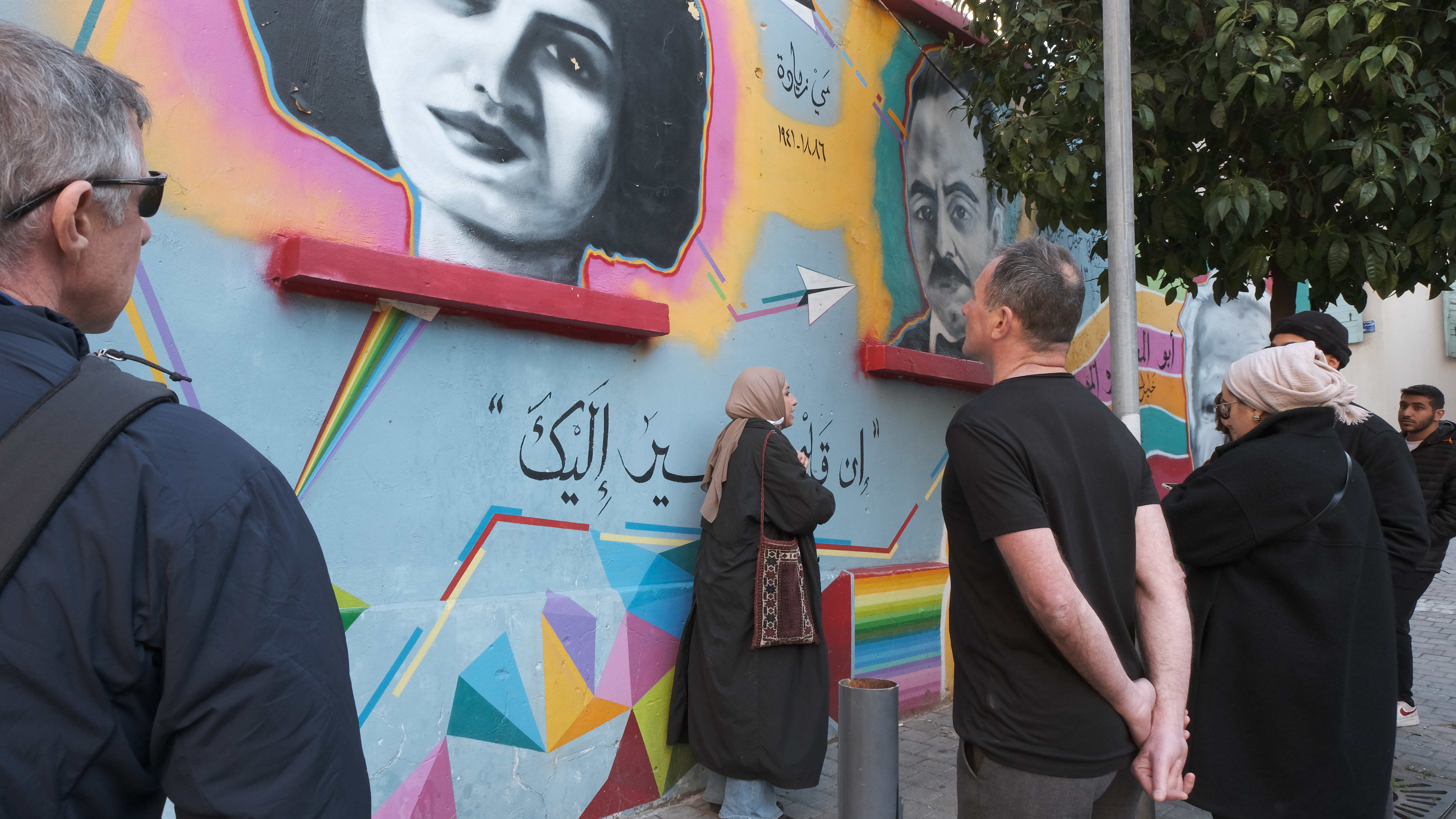
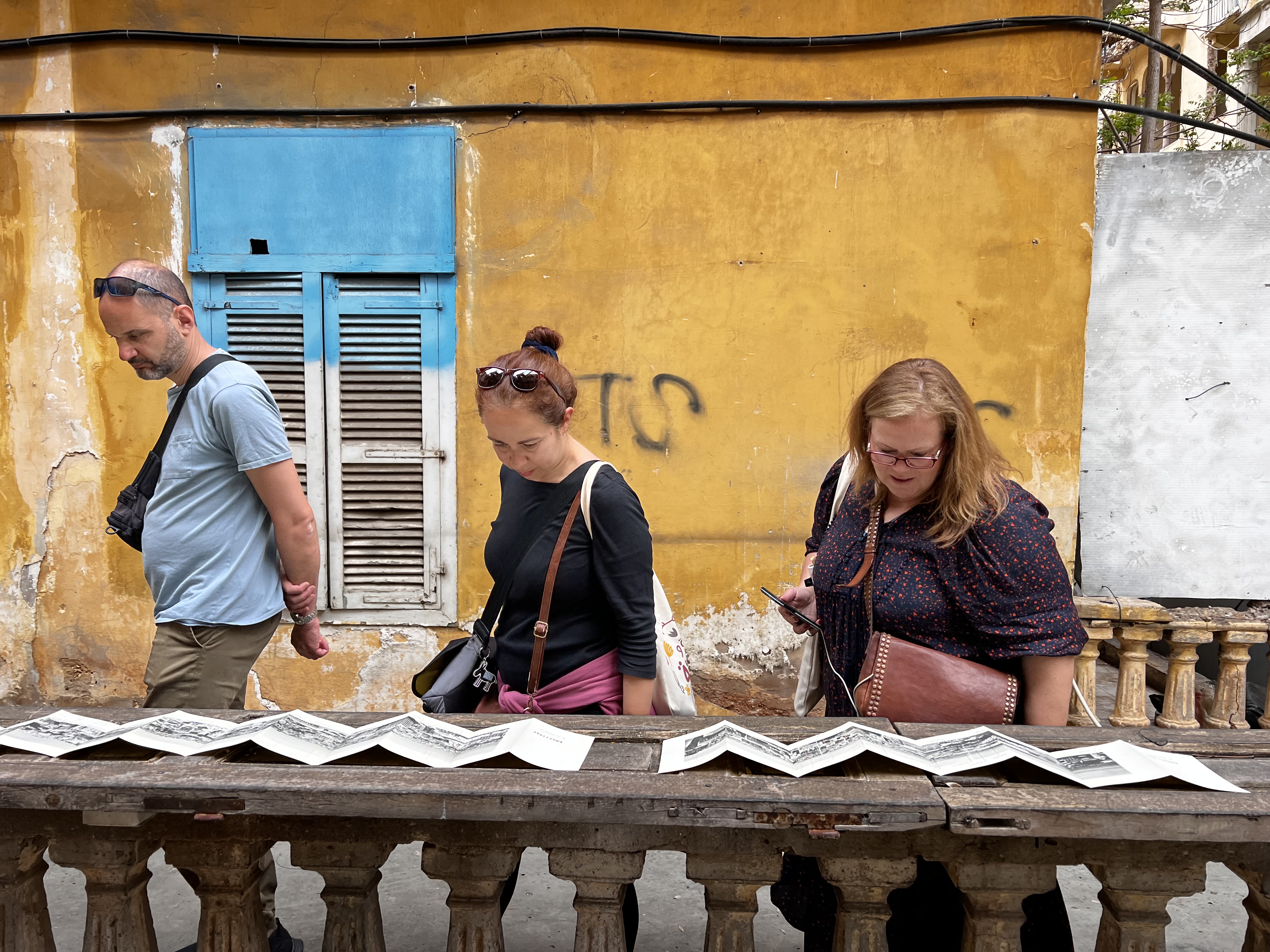
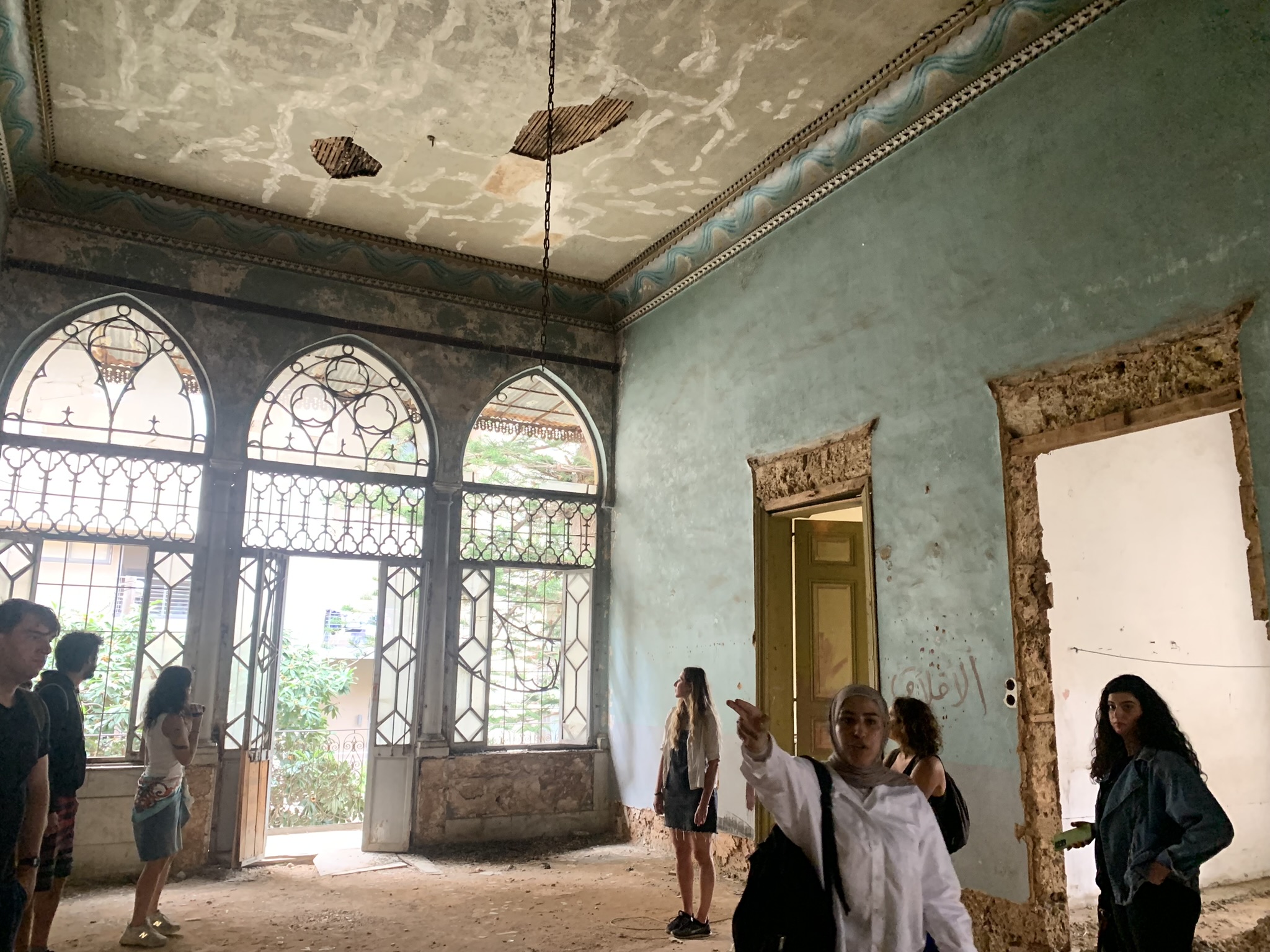
But there was another hurdle for Samira to overcome. On Samira’s social media her tagline was “Guiding you around Beirut”, and one day she got a message from the Lebanese Tour Guides Syndicate informing her that it was not legal to be a tour guide without being licensed by the Ministry of Tourism. But there was a catch – in order to be approved, she needed to attend an intensive 600 hour training course by the Ministry of Tourism; but there were no dates for the course. “Do you think this was just organisational problems, or deliberate?” I asked her. “No, it’s more like there is a lack of funding” she said, “I also heard that this workshop is only to be launched if there is a need in the market for licensed tour guides”. So after a lot of angst and badgering of the Lebanese Tour Guides Syndicate in a bid to ensure she did things the legal way, Samira enrolled on a 3-year Tourism Guidance major at the Lebanese University. Next academic year, in 2024/25, she’ll graduate as a licensed tour guide. “..And until now the Ministry of Tourism still hasn’t put on their workshop!” she said laughing. “And i’m actually kind of glad it’s worked out this way you know. On my course at the moment I’m getting to know archeologists, …the explorations that they did in downtown Beirut after the war….. I did my training at the famous Sursock Museum…I know alot of professors working on this stuff….It’s very insightful”.
“I also decided to leave the agency I was with because I realised none of them was a licensed tour guide and I didn’t want any trouble in future” She told me. “So I went solo”. And Samira took her ‘baby’, The Green Line Walking Tour, with her.
The Beautiful Small Things
While Samira tends to get more expats or Lebanese diaspora than locals on her tour, she does get alot of interest from locals too. “When I have Lebanese [on the tour] it’s always more exciting because they get to speak their narrative as well. So it’s always more nourishing and enriching on the tour when we have locals along too”.
“When you are a local, wherever you live in the world, you can get carried away with day to day life and getting food on the table” Samira went on. “But this is what I try to tell people from Lebanon, I say ‘If you want to tolerate living in Beirut, or in Lebanon, you should think in a tourist mentality. and focus on the beautiful small little things’. – That’s it or else it will be at some point unbearable” she added, referring to all of the difficulties, turbulence, and instability Lebanese people are subjected to. “Soo yeah, I try to tell people that. I’ve had it since I was a kid. You know even when i was studying English Literature back in 2016/17 my friends always made fun of me for seeing a traffic light or a piece of graffiti on the street and then getting excited about it” she said laughing “- but it’s really when you see small things, alot of different topics ignite whether it is sociology, anthropology, politics, history…”
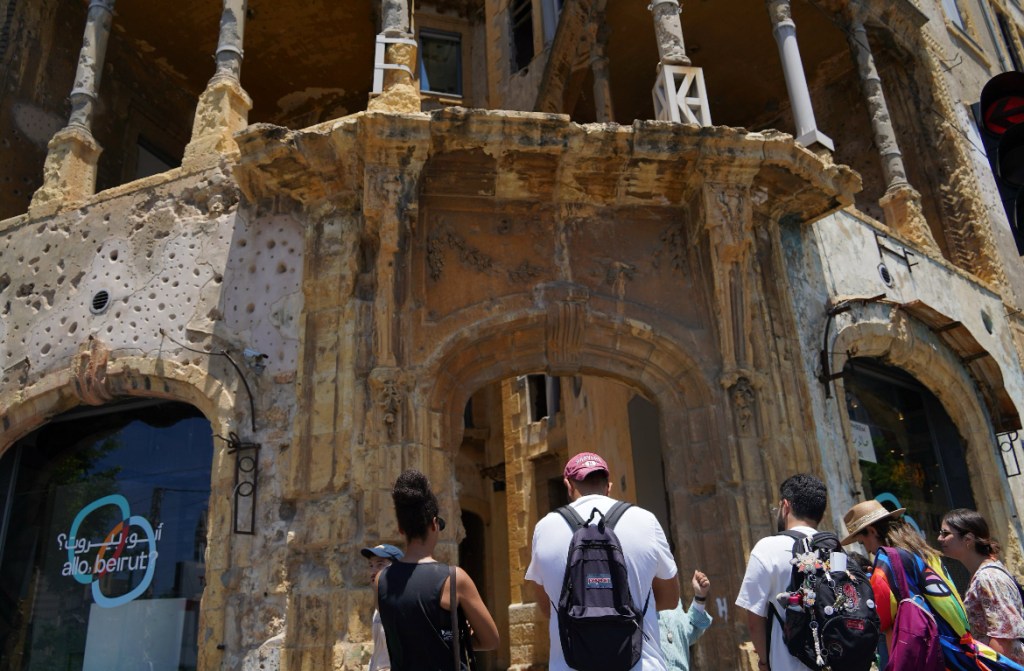
Invisible Boundaries
“Some local Lebanese are still psychologically stuck in east or west Beirut” Samira told me. And not just in Beirut but across all of Lebanon: where somebody is from will often determine which other areas they feel comfortable visiting, usually along sectarian lines. “And now we also have many people who are too young to remember the war, and their parents don’t want them to know much about the war so they don’t know much about it; but because they’ve been raised in a household….. a lot of these people still just don’t feel comfortable crossing the green line. So there aren’t those physical borders they had in the past, they don’t have an actual wall or anything, but it’s like a psychological boundary”.
Samira went on to tell me 2 stories, One about an eldery Christian woman who ever since the war can’t bring herself to cross the highway into Bechara El Khoury, from Beit Beirut. Although they are just steps away from each other, psychologically Beit Beirut is her territory and if she went further up the road she’d be in ‘West Beirut’ and she can’t overcome that psychological barrier. The second story was about a conservative muslim woman wearing a full kaboot / niqab (less common to see in Beirut) and her husband and children. They had seen Samira’s social media content about a free exhibition at the beautiful Sursock Museum and had ventured into this very Christian, very cosmopolitan neighbourhood to come to the exhibition. “…And you could see that they were outside of their comfort-zone” said Samira, “but they were there for their kids and it was so heart-warming to see them overcome those psychological barriers, I appreciated it so much”. Both of these stories speak to the wounds and generational trauma caused by the civil war, and that can maybe even be traced back further, to the creation of modern Lebanon with Sykes-Picot and the divisions upheld by the confessional political system….but for me they also speak to how important Samira’s work is, and it’s potential to contribute, even if on a small scale, to collective healing. Little by little, Samira is encouraging people to be curious about each other and their own country in a way they maybe hadn’t thought to do before, and this can be powerful.
“There are actually alot of free things in the city” Samira told me. Samira also has a broadcast channel on instagram and telegram, where she posts all of the cultural events going on in Beirut. “Opening nights are for free, (and you can often get a free drink!). If you need to register I do mention and explain. But I just want to let people know that arts and culture, they are accessible…. But some people you know even if they are free, they still wouldn’t feel comfortable going to that place themselves. But i’m like you know what, dress up, it’s fun! Be someone else for the night! You never know what you will discover”.
A Falafel Vendor Older than Great Lebanon Itself
“Two days ago i was at the falafel shop” Samira told me. “This vendor, it’s older than Great Lebanon itself. It’s been in Beirut since 1914! And I got talking with the owner, Abou Ziad, whose family has been running the business since it began, and he started telling me about his life. I asked him if I could take some videos to share his stories with other people… and this is how it happens you know. Lots of people were amazed to see these videos”.
“So this is what I always say you know, just talk to people a little bit. Maybe you go to get your veggies from this shop… talk to him! Get to know him! You know maybe he’s been here for 50 years. Ask him how he is…. just take it bit by bit, little by little, and maybe he starts to get to know you more, and he starts telling you stories, and it’s igniting. And this is what I share in my stories.”
Tears and Astonishment
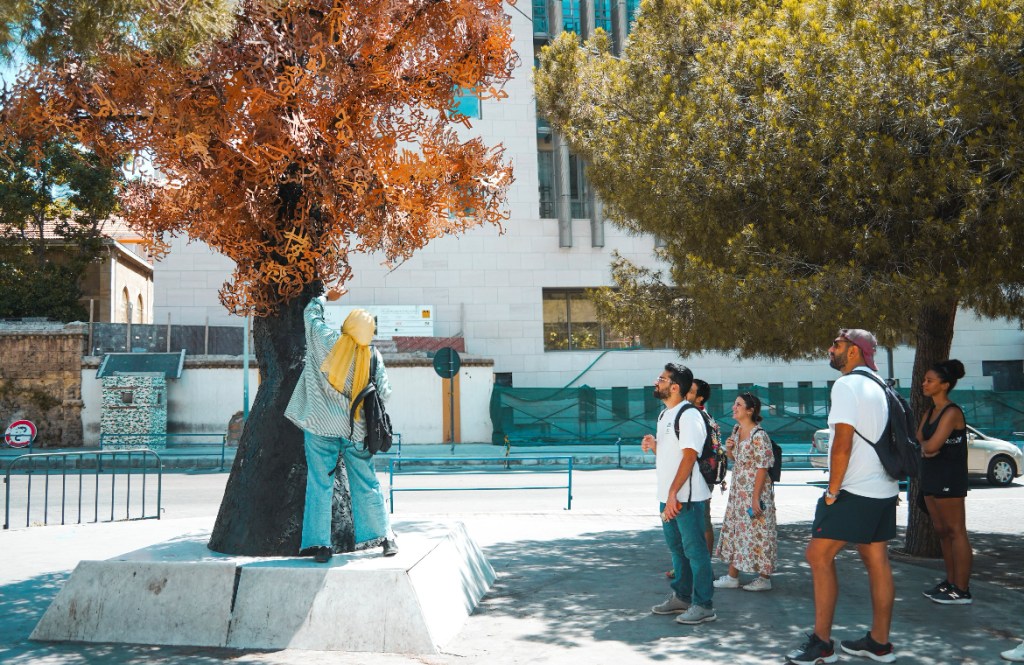
I asked Samira about the reactions she gets from people who go on her tour. “I had a few who cried. especially those who lived the war. I had some who were mesmorised with the heritage houses, because they never saw such an activity as urbexing. And I’ve had astonishment. Especially for locals who are like ‘we passed by here every single week, every single day, and we didn’t know the story of this…or we never payed attention to it’. And I understand it because mostly you are in your cars. You are focussed on your destination. You’re not focussed on whatever is surrounding you, or on the stories that are just one conversation away” she said. “So I feel so happy when I get that from locals. It just brings me joy to see how their eyes ignite with curiosity when you start telling them those stories. It’s beautiful!”
Competing War Narratives
Did you know that in Lebanon, people don’t learn about the civil war at school? There is no one agreed narrative of what happened. So I was really interested as to how Samira went about researching for her tour, and how she managed to create a tour that was so educational and doesn’t shy away from sharing in-depth nuanced information, but at the same time is upfront about the fact there is no one subjective narrative. It’s surely a difficult feat, and I was so impressed with how unusually thoughtful and sensitive Samira’s tour was. “Yes, so personally I think (as do the Lebanese Association for History) that it’s too early to agree on a narrative of the war” Samira told me. “Especially that we have current politicians who were warlords. So obviously it wouldn’t be easy for the Ministry of Education and it’s also not a first priority with inflation, and with the political situation….with wars happening every now and then. And with official government employees barely getting paid properly….So…for me to do a tour about very recent history with no main agreed academic narrative there. It was hard for me”.
“I believe there’s supposed to be different narratives” she went on, “So I had to tackle this from different perspectives. I had to do a lot of research. I watched testimonials of ex-Fighters, from Fighters for Peace, I also did their tour. I listened to the audio guide I mentioned earlier. I read books that have subjective narratives about the war too, from different perspectives: from the leftists, from the PLO, from the Israeli narrative, from the right-wing narrative, to understand and to get to know people from different backgrounds….rightwing or leftwing or pro-palestinians or pan-arabists backgrounds to understand the narratives and represent it. I also attended workshops related to the war, like ‘Memory of War’ by forumZFD. I watched the 9 hour Al Jazeera documentary about the war; I studied the American University of Beirut’s website where they have an in-depth page related to the war with resources; and I also studied the BBC’s coverage. I also go to a lot of events or screenings related to the war… so I’m always open to any any event related to this topic so I can listen to as much as possible. And mainly, mainly I read a lot of books”.
“It’s a continuous education, it’s not like I completed it and then I decided to start to the tour. I started the tour while I was learning. And of course, now I’m more equipped than ever. And the more I learn and learn and learn more with the years, I get more and more more equipped and develop deeper understandings”.
And true to this honoring of different perspectives, Samira sends a thank you email out to each participant on her tour at the end, including links to different narratives “And the audience gets to decide which one they believe it” she says.
Message to the World
I asked Samira, if she had one message to share with people outside of Lebanon, who don’t know Lebanon, what would it be.
“You have your Lebanon and its dilemma. I have my Lebanon and its beauty. Your Lebanon is an arena for men from the West and men from the East.
My Lebanon is a flock of birds fluttering in the early morning as shepherds lead their sheep into the meadow…..
…..You have your Lebanon and I have my Lebanon”
Excerpt from poem ‘You have your Lebanon’ by Khalil Gebran, quoted by Samira.
“Mainly just to say to people, why don’t you try something new?” said Samira. “You don’t have to accept it or to like it. But you can be curious. And for people in the West: Lebanon is a really tiny country, and it has 18 different religious sects. Lebanon was mentioned in the Bible and it’s thousands of years old, but it was only born as a modern country with it’s current borders in 1920. So, whatever you see on the news, if you see any country that is only 100 years old maybe less, it’s very normal for them to have political tensions. Especially that geopolitically speaking we are surrounded by much bigger countries that have conflicts with occupied Palestine, and the Israeli borders, and we have Syria in the north. So it’s not easy for us. So, just take that into consideration. Yes It’s quite often to see some tensions happening every few years because…we’re trying to figure out us as a country. We are a country of minorities. The majorities are Maronite Christians, Muslim Sunni and Muslim Shia, but there is no one majority. And our country was born in a sectarian context. Our parliament is structured this way. So there’s no one narrative”.
“But also because of this, Lebanon is way more historically and culturally rich”. Samira went on. “It’s beautiful. It’s a country where you can do so many touristic activities in just one day because of the distance – it’s so easy to get from one end of the country to the other. Archaeologically speaking, we are in the melting pot of the fertile crescent that gave birth to some of the earliest civilisations, the gateway between ancient Egypt and ancient Mesopotamian civilisations. We are on what was the trade route between the pharoahs and the Assyrians, Babylonians, and later the Archaemenid Persians. Alexander the Great passed through here, and we have some of the worlds best Roman ruins. Beirut and Lebanon was and still is the door from Europe to the East. So as well as the difficulties, there is so much beauty.”
Samira, you are such a ray of sunshine, and I learn a lot from you. In igniting our openness and curiosity, you are also encouraging us all to respect each other and our diversity a little more; And Lebanon’s rich diversity in culture, people, history, and landscape is surely what makes this country so incredibly special. Thank you for brightening Beirut up for all of us.
More
In September look out for Samira’s new co-creation project with Dar Onboz, called “Tajwal” (Arabic for ‘wander’) :a series of guided tours focusing on crafts, through 4 different areas in Beirut, as a funded project from BERYT.
Samira has also launched another tour: ‘Kazdoura Beirutiye’. Kazdoura means ‘stroll’ in Arabic, and this tour is a private guided tour where Samira offers customised routes based on your interests. Her new website is coming soon too so watch this space.
For all things tours, follow Samira on the links below:
To follow Samira’s content creation as she continues to explore Beirut, and to sign up to her broadcast channel, where she posts live updates of all the cultural events around Beirut, follow @Samirablogs on instagram.
Finally, you can register for The Green Line Walking Tour directly through her social media bio’s, or on this link.


- Even the term ‘Civil War’ is sometimes contested due to it’s implication that the war was between civil actors, even though from the beginning external actors were involved in the violence. ↩︎
 The Beirut Bulbul.